


Cosmetic labeling requirements Canada: a compliance guide
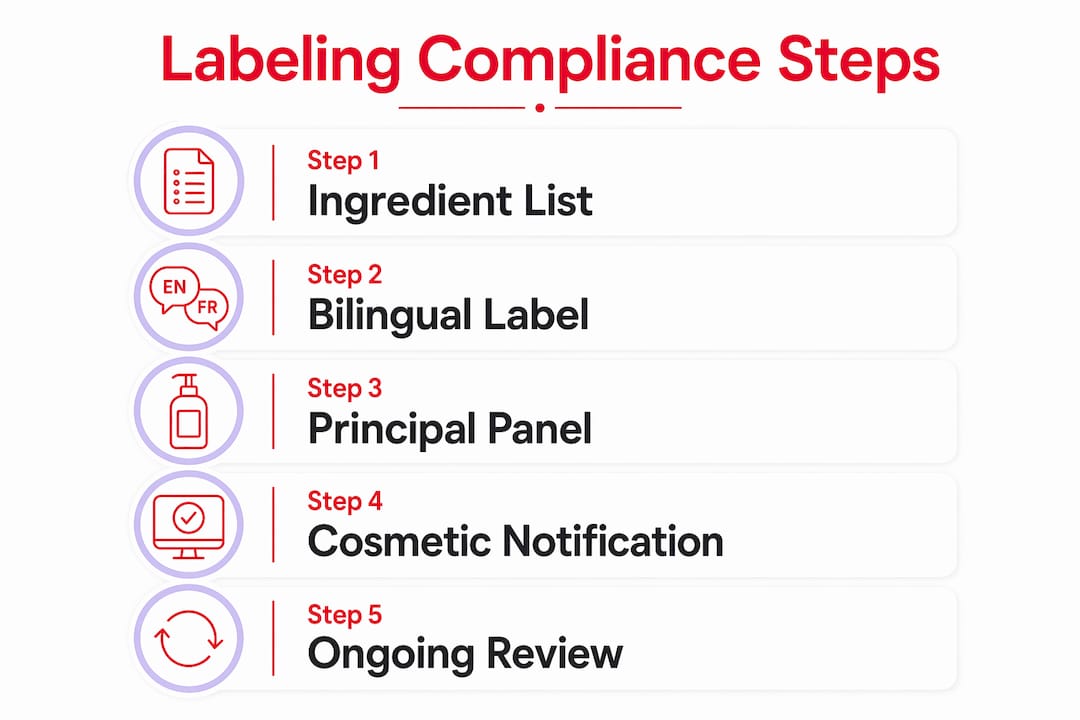
Every cosmetic sold in Canada must carry a product identity, a net quantity in metric units, dealer contact information and principal place of business, an INCI ingredient list on the outer label, and any required warnings — with most of that information in both English and French. Your immediate next step: draft your label copy against that checklist, then submit a Cosmetic Notification Form (CNF) within 10 days of your first sale in Canada.
Before you read further, confirm these three things:
- Your ingredient list uses INCI names in descending order of concentration, with “parfum” or “aroma” for fragrance blends.
- Your principal display panel (PDP) shows product identity and net quantity in both English and French, in type at least 1.6 mm tall.
- You have a CNF ready to submit, and your safety documentation is on file.
If any of those three are missing, this guide tells you exactly how to fix them.
Table of Contents
- Which federal laws govern cosmetic labelling in Canada?
- What must appear on a Canadian cosmetic label?
- Where does information go on the label? PDP and information panels explained
- How to build a compliant INCI ingredient list
- What must be bilingual and what is exempt?
- Cosmetic Notification Form: what to submit and when
- When does a cosmetic claim cross into drug territory?
- How Health Canada enforces labelling rules
- Pre-sale compliance checklist and sample label layout
- Practical notes for salon product retailers and manufacturers
- Key takeaways
- Compliance is ongoing, not a one-time task
- Authoritative sources for further reading
Which federal laws govern cosmetic labelling in Canada?
Three statutes and their associated regulations create the entire framework. The Food and Drugs Act is the parent legislation; the Cosmetic Regulations (C.R.C., c. 869) sit under it and contain the specific labelling rules, CNF requirements, and prohibited ingredient provisions. The Consumer Packaging and Labelling Act (CPLA) and its regulations add requirements for net quantity, product identity, and dealer identification on pre-packaged products.
Health Canada is the competent federal regulator. It maintains the Cosmetic Ingredient Hotlist, a list of substances that are prohibited or restricted in cosmetics sold in Canada. Compliance with the Hotlist is mandatory, and dealers bear full responsibility for it — Health Canada does not pre-screen formulations.
One point that surprises many first-time importers: there is no licence required to sell cosmetics in Canada. The CNF is a notification, not an approval. That distinction matters because it means the regulatory burden sits entirely with the manufacturer or importer, not with a government gate. If your product later turns out to be non-compliant, submitting a CNF offers no protection from enforcement.
What must appear on a Canadian cosmetic label?
The Cosmetic Regulations and the CPLA together require the following on every cosmetic label. Think of this as your non-negotiable checklist:
- Product identity. The common or generic name, or a description of function, must appear on the PDP. “Moisturising Cream” or “Hair Conditioner” qualifies; a made-up brand name alone does not.
- Net quantity in metric units. Volume in millilitres or litres, mass in grams or kilograms. Metric symbols are considered bilingual on their own.
- Dealer identity and principal place of business. The company name and full mailing address (no P.O. boxes) of the Canadian manufacturer or importer. This may appear in English or French only — it is one of the few elements exempt from the bilingual requirement.
- Consumer contact information. A telephone number, email address, website, or postal address where consumers can reach someone with questions. The Cosmetic Regulations require that this contact be able to provide timely bilingual responses.
- INCI ingredient list. Must appear on the outer label, in descending order of concentration. This is the one element that does not need to be bilingual — INCI names are internationally standardised.
- Warnings and directions for safe use. Required when the product presents an avoidable hazard. Hair dyes, pressurised containers, products containing methyl alcohol or bromates, and mercury-containing preservatives each carry specific mandatory statements under the Cosmetic Regulations.
- Legibility and durability. All required text must be clearly legible and remain so throughout the useful life of the product under normal conditions of sale and use. Contrast between text and background is not optional.
A note on inner vs. outer labels: When a product has both an inner and outer label, the ingredient list must appear on the outer label. If there is only one label, it must carry everything required for both. Ornamental containers with a separate outer package follow the outer-label rules for ingredients; the inner container still needs contact information and product identity.
Where does information go on the label? PDP and information panels explained
The principal display panel is the portion of the label most likely to be seen by a consumer at the point of purchase. Under the CPLA requirements, two declarations must appear there: product identity and net quantity. Everything else — the ingredient list, dealer contact, warnings — may appear on an information panel (the back or side of the label), provided it meets legibility standards.
Minimum type size is 1.6 mm (1/16 inch) in height, measured against a lower-case “o” when mixed or lower-case type is used. That rule applies to the product identity declaration, the non-numeric portion of the net quantity, and the dealer name and address. It is a hard floor, not a guideline.
A few practical scenarios worth knowing:
- Single-label products (a tube with one label wrapping around it): the PDP is the front panel. Net quantity and product identity must be there; the rest can wrap to the back.
- Small containers where the label is physically too small to carry a full ingredient list: the Cosmetic Regulations permit the ingredient list to appear on a tag, leaflet, or card attached to the container, provided the outer label or package directs consumers to it.
- Ornamental containers sold without an outer package: the inner label must still carry all required information. If the container’s shape makes a full label impractical, a hang tag is an accepted alternative — but it must be durable and attached in a way that survives normal retail handling.
A common pitfall: putting the bilingual product identity only on an inner label that is not visible through the outer packaging. If a consumer cannot read it at the shelf, it does not satisfy the PDP requirement.
How to build a compliant INCI ingredient list
The Cosmetic Regulations are specific about how the ingredient list is constructed. Get this wrong and you will face a non-compliance finding on inspection.
- INCI names only. Every ingredient on the outer label must use its International Nomenclature of Cosmetic Ingredients name. Marketing names, trade names, and common English names are not acceptable substitutes.
- Descending order by weight. List from the highest concentration to lowest. Ingredients present at 1% or less may be listed in any order after those above 1%, but you must be able to demonstrate the concentration on request.
- Botanicals need genus and species. “Aloe” is not sufficient. The correct form is Aloe barbadensis leaf juice or the full INCI botanical name. Mixing INCI with translated names is a documented source of non-compliance findings during inspections.
- Fragrance shorthand. Fragrance components may be declared collectively as “parfum” or “aroma.” However, as of April 12, 2026, specified fragrance allergens must be individually declared on the CNF when present above threshold: greater than 0.01% in rinse-off products, greater than 0.001% in leave-on products. Phased-in labelling changes for some of those allergens are also underway.
- Colour cosmetics sold in shade ranges. All colourants used across the range may be listed together, preceded by “+/–” or “±” or the phrase “may contain/peut contenir.”
- No marketing language inside the INCI list. Do not insert phrases like “natural” or “organic” between ingredient names. The list is a technical declaration, not an advertising space.
- Ingredients with no INCI name. List by chemical name. This is rare but applies to novel or proprietary ingredients not yet assigned an INCI designation.
What must be bilingual and what is exempt?
Canada’s bilingual labelling requirements apply to virtually every mandatory label element — with one deliberate exception.
Must be in both English and French:
- Product identity (common name or function)
- Net quantity declaration (metric symbols are inherently bilingual; the word “millilitres” must appear in both languages if spelled out)
- Warnings and cautions
- Directions for safe use
- Any other mandatory label information under the Cosmetic Regulations
Exempt from bilingual requirement:
- The INCI ingredient list. This exemption is intentional: INCI names are internationally standardised, and requiring French translations would create inconsistency with global labelling norms. The onus shifts to manufacturers to ensure all other label content is accurately translated.
- Dealer name and principal place of business (may appear in one official language).
For layout, you have two accepted approaches: parallel bilingual (English and French side by side in columns) or stacked bilingual (English block above or below the French block). Either works, provided both versions meet the minimum type size and are equally prominent. The CPLA also allows one official language on the PDP and the other on a panel of equal size and prominence — useful for larger containers with distinct front and back panels.
Pro Tip: Have a professional translator review your French label copy before printing. Health Canada non-compliance letters frequently cite poor or machine-translated French on warnings and directions — errors that are expensive to correct after a print run.
Quebec has additional requirements under the Charter of the French Language. Products sold in Quebec must have French text at least as prominent as any other language on the label. If you are selling nationally, designing your label to meet Quebec’s standard from the start is far more efficient than maintaining a separate Quebec SKU.
Cosmetic Notification Form: what to submit and when
The CNF is mandatory. Every manufacturer and importer must submit it within 10 days of first selling a cosmetic in Canada. Here is exactly what goes into it:
- Contact information from the inner label (telephone, email, website, or postal address).
- Product name as it appears on the label.
- Product function, including whether it is a leave-on or rinse-off product.
- INCI ingredient list with concentrations — either exact percentages or the concentration ranges specified in the CNF table. Ranges are acceptable; vague descriptions are not.
- Form of the cosmetic (cream, gel, spray, powder, etc.).
- Name and Canadian address of the manufacturer or importer.
- Name and address of the formulator, if different from the manufacturer or importer.
- Copies of labels and inserts, but only when the product requires special labelling under sections 22 to 24 of the Cosmetic Regulations (mercury preservatives, pressurised containers, avoidable hazard warnings).
- Fragrance allergen disclosures where allergens exceed the thresholds noted above — this is a newer CNF field that must mirror what appears on the label.
- Signature of the person submitting the notification.
For record-keeping, maintain the following for every product line: the original CNF submission and any amendments, safety data for each ingredient, evidence of Hotlist compliance, label drafts and print-ready files, translation records, and the date of first retail sale in Canada. If Health Canada inspects or requests information, these are the documents you will need to produce.
Update your CNF whenever the formulation or label changes. The CNF is a living record, not a one-time filing.
When does a cosmetic claim cross into drug territory?
The line between a cosmetic and a drug is drawn by the claim, not the ingredient. A cosmetic claim describes an effect on appearance: cleansing, conditioning, colouring, or altering the look of skin or hair. A drug claim describes an effect on the body’s structure or function: treating dandruff, preventing hair loss, reducing inflammation, or affecting skin chemistry.
| Claim type | Example phrasing | Regulatory outcome |
|---|---|---|
| Cosmetic | “Leaves hair looking thicker” | Cosmetic Regulations apply |
| Cosmetic | “Cleanses and conditions” | Cosmetic Regulations apply |
| Drug | “Treats dandruff” | Drug Identification Number required |
| Drug | “Stimulates hair follicles to regrow hair” | Natural Health Product or drug classification |
| Drug | “Reduces skin inflammation” | Drug classification, clinical evidence required |
| Borderline | “Strengthens hair from within” | Risk of reclassification; avoid |
| Borderline | “Clinically proven to repair” | Triggers evidence requirement under Cosmetic Regulations s. 21 |
Red-flag language includes: “treats,” “prevents,” “heals,” “repairs at the cellular level,” “stimulates,” “clinically proven to affect,” and any reference to influencing the chemistry of skin, hair, or teeth. Under section 21 of the Cosmetic Regulations, a manufacturer making any claim about a cosmetic’s ability to influence skin, hair, or tooth chemistry must have evidence to validate it — and that evidence must be available on request.
If your product is reclassified as a drug, it requires a Drug Identification Number (DIN) or Natural Product Number (NPN) before it can be sold. That is a fundamentally different regulatory pathway with clinical evidence requirements, and it cannot be resolved by relabelling alone.
How Health Canada enforces labelling rules
Health Canada’s enforcement toolkit is broad, and submitting a CNF does not insulate you from any of it. Enforcement is triggered by health risk and by misleading representations — and both can arise from labelling failures.
- Stop-sale orders freeze distribution of a non-compliant product immediately.
- Import refusals block products at the border when labelling or CNF deficiencies are identified by the Canada Border Services Agency.
- Product recalls — voluntary or mandatory — require the dealer to notify downstream customers, quarantine stock, and report corrective actions to Health Canada.
- Seizure of product is available under the Food and Drugs Act when a product presents a health risk.
- Prosecution is possible for serious or repeat violations, including selling a cosmetic with a prohibited ingredient or making false representations about safety.
Common triggers for enforcement include: hazardous ingredients on the Hotlist, missing required warnings (hair dye cautions, pressurised container hazard statements), false or misleading therapeutic claims, and failure to submit a CNF at all.
If you receive a non-compliance notice, act immediately: quarantine the affected stock, notify any retailers or distributors who received it, correct the label, update the CNF if the formulation or label has changed, and document every step of your corrective action. An audit trail of your response is your best defence in any subsequent enforcement proceeding.
Pre-sale compliance checklist and sample label layout
Run through this before your first shipment reaches a Canadian retailer or consumer.
Pre-sale checklist:
- [ ] INCI ingredient list verified against the Cosmetic Ingredient Hotlist — no prohibited or restricted substances.
- [ ] Ingredient list on the outer label, in descending order of concentration, using INCI names only.
- [ ] Botanicals listed with genus and species.
- [ ] Fragrance allergens above threshold individually declared on CNF (and on label if phased-in labelling dates apply).
- [ ] Product identity (common name or function) on the PDP in both English and French, minimum 1.6 mm type.
- [ ] Net quantity in metric units on the PDP, bilingual, minimum 1.6 mm type.
- [ ] Dealer name and full Canadian mailing address (no P.O. box), minimum 1.6 mm type.
- [ ] Consumer contact information (phone, email, website, or postal address) on the inner label.
- [ ] All required warnings and directions for safe use present and bilingual.
- [ ] Label text legible and durable under normal use and storage conditions.
- [ ] CNF submitted within 10 days of first sale, with label copies attached if special warnings apply.
- [ ] Safety documentation on file: ingredient safety data, Hotlist compliance evidence, translation records, label drafts, first-sale date.
- [ ] No therapeutic claims on label or in advertising.
Sample label layout (non-branded reference):
Principal Display Panel (front):
- Product identity: “Moisturising Shampoo / Shampooing hydratant”
- Net quantity: “250 mL”
Information Panel (back):
- INCI ingredient list (descending order, no bilingual requirement)
- Dealer: “Distributed by [Company Name], [Full Street Address], [City, Province, Postal Code], Canada”
- Contact: “[phone] | [email] | [website]”
- Warnings/directions (bilingual if mandatory)
For small containers where the back panel cannot fit the full ingredient list, attach a durable tag or leaflet and print on the container: “See enclosed leaflet for ingredient list / Voir la notice ci-jointe pour la liste des ingrédients.”
Health Canada’s Industry Guide for the Labelling of Cosmetics includes worked examples and is the most practical official reference for label layout questions.
Practical notes for salon product retailers and manufacturers
For salon owners and professional product retailers, label compliance is not just a regulatory obligation — it is a purchasing decision. Accepting non-compliant stock creates liability, and Health Canada’s enforcement actions can reach retailers, not just importers.
When verifying incoming stock from a supplier:
- Request CNF evidence or confirmation that a CNF has been submitted for each product.
- Check that the outer label carries an INCI ingredient list — if it is missing, the product is non-compliant on its face.
- Confirm the PDP shows product identity and net quantity in both English and French.
- Verify the dealer’s Canadian address is present and complete (no P.O. box).
- Cross-reference any unfamiliar ingredients against the Cosmetic Ingredient Hotlist before accepting the shipment.
At the receiving dock:
- Check label legibility physically — peel-prone labels or faded print are a compliance risk.
- Flag any product with therapeutic claims (“regrows hair,” “treats scalp conditions”) for review before putting it on the shelf.
- Confirm that pressurised containers carry the required hazard statements.
Salonbrandz sources professional salon products from suppliers who meet Canadian regulatory standards, which means the products arriving at your salon carry the label information your clients and staff need. When you are evaluating a new product line, the common mistakes salons make when choosing hair products often come down to skipping the label check entirely — a shortcut that can result in a stop-sale order on your inventory.
Pro Tip: Train your receiving staff to check three things on every new product: INCI list on the outer label, bilingual product identity on the PDP, and a Canadian dealer address. Those three checks catch the majority of non-compliant imports before they reach the shelf.
Key takeaways
Every cosmetic sold in Canada must carry a bilingual PDP, an INCI ingredient list on the outer label, metric net quantity, a Canadian dealer address, and consumer contact information — and a CNF must be filed within 10 days of first sale.
| Point | Details |
|---|---|
| INCI list is mandatory | Every ingredient must appear on the outer label by INCI name, in descending order of concentration. |
| Bilingual PDP required | Product identity and net quantity must appear in English and French; minimum type height is 1.6 mm. |
| CNF within 10 days | Submit the Cosmetic Notification Form to Health Canada within 10 days of first selling in Canada. |
| CNF is not an approval | Filing a CNF does not protect you from enforcement; safety responsibility stays with the dealer. |
| Therapeutic claims trigger reclassification | Any claim that the product treats or prevents a condition can reclassify it as a drug, requiring a DIN or NPN. |
Compliance is ongoing, not a one-time task
Label compliance tends to get treated as a launch checklist item — something you do once and file away. That framing is where most enforcement problems start. Formulations change, ingredient suppliers change, and Health Canada’s Hotlist and CNF requirements evolve. The fragrance allergen disclosure rules that came into effect in April 2026 are a good example: products that were fully compliant a year earlier required CNF updates and, for some allergens, label changes.
The smarter approach is to build label review into every product update cycle, not just new launches. When a supplier changes an ingredient, that triggers a Hotlist check, a CNF amendment, and potentially a label revision. When a new regulatory amendment is published, your existing product lines need to be assessed against it.
For salon retailers and professional product buyers, the same logic applies on the procurement side. A product that was compliant when you first stocked it may not be compliant after a reformulation — and the label may not make that obvious. Routine supplier checks and staying current with Health Canada guidance are the practical tools for managing that risk.
Salonbrandz is built around sourcing products that meet Canadian professional standards. If you have questions about what to look for on a label or how to verify a supplier’s compliance claims, that is exactly the kind of conversation worth having before a shipment arrives.
Authoritative sources for further reading
These are the primary official references you should bookmark for label QA and CNF submissions:
- Cosmetic advertising, labelling and ingredients — Canada.ca: Health Canada’s central hub for labelling obligations, bilingual requirements, and INCI rules. Start here.
- Labelling of Cosmetics — Consumer Product Safety, Canada.ca: Covers product-specific labelling requirements, warnings for hazardous products, and pressurised container rules.
- Industry Guide for the Labelling of Cosmetics — Canada.ca: The most practical official document for PDP layout, inner/outer label rules, and worked examples. Download and keep it with your label templates.
- Guide to Cosmetic Ingredient Labelling — Health Canada (PDF): Technical rules for INCI names, botanical naming, listing order, and fragrance shorthand.
- Notification of Cosmetics: Guide for Cosmetic Notifications — Canada.ca: The CNF submission guide, including required fields, concentration range tables, and the updated fragrance allergen disclosure requirements.
- Cosmetic Regulations (C.R.C., c. 869) — Justice Canada: The full text of the regulations. Sections 18 to 30 cover labelling and CNF requirements directly.
- Cosmetics Regulatory Information — Canada.ca: Overview of dealer obligations, the Hotlist, and enforcement framework.
- Guide to the Consumer Packaging and Labelling Act and Regulations — Competition Bureau Canada: The CPLA reference for net quantity, product identity, and dealer information requirements.
Save these links in your compliance folder alongside your CNF submissions and label drafts. When Health Canada publishes an amendment, these pages are updated first.
This article provides general regulatory information for Canadian cosmetic manufacturers, importers, and retailers. It is not legal advice. Confirm current requirements with Health Canada or a qualified regulatory consultant before your first sale.


