


Best barber shears for Canadian pros: 2026 guide
For most full-time barbers in Canada, the right starting point is a convex-edge shear with a semi-offset or crane handle in ATS-314 or VG-10 steel in a 6.5–7.0" length. That size gives you the leverage and blade coverage you need for scissor-over-comb and fade work without sacrificing control on detail cuts. The steel grade matters because it determines how long you go between sharpenings, and the handle shape determines whether your wrist survives a ten-hour Saturday.
Quick recommendation:
- Length: 6.5–7.0" for scissor-over-comb, fades, and bulk removal; 5.5–6.0" for detailing and beard work
- Edge: Convex for slide cutting and fades; bevel for blunt cuts and over-comb
- Steel: ATS-314 or VG-10 for edge retention; 440C as a solid, budget-friendly baseline
- Handle: Semi-offset or crane for reduced wrist extension during long shifts
- Where to buy in Canada: Salonbrandz ships professional shears across Canada and offers in-store pickup in Scarborough near Toronto
Table of Contents
- Which shear size and blade type suit your barbering tasks?
- How to choose professional barber shears: a practical checklist
- How to keep your shears sharp and precise over years of use
- Ergonomic handle designs that protect your wrists and hands
- Are expensive shears worth it for professional barbers?
- Final recommendation and buying workflow for Canadian barbers
- Key takeaways
- What actually matters when you buy shears
- Professional shears, shipped across Canada
Which shear size and blade type suit your barbering tasks?
Not every cut calls for the same tool. Matching shear length and blade geometry to your technique is what separates a smooth shift from a grinding one.
Size-to-task reference
| Shear size | Best for | Why |
|---|---|---|
| 5.5" | Beard detailing, tight perimeter work | Short blade = precision control in small areas |
| 6.0" | Point cutting, textured styles, general styling | Versatile length for most salon-style cuts |
| 6.5" | Scissor-over-comb, blending, mid-fades | Longer reach reduces repositioning per pass |
| 7.0" | High-volume scissor-over-comb, bulk removal, fades | Maximum coverage and leverage per cut |
| 7.5"+ | Barbershop bulk work, experienced hands only | Requires strong wrist control; not ideal for beginners |
Moving from a 6.0" to a 7.0" shear materially increases cutting rhythm and reduces the number of passes per section, which compounds into real time savings across a full day of back-to-back clients.
Convex vs. bevel edge: which do you need?
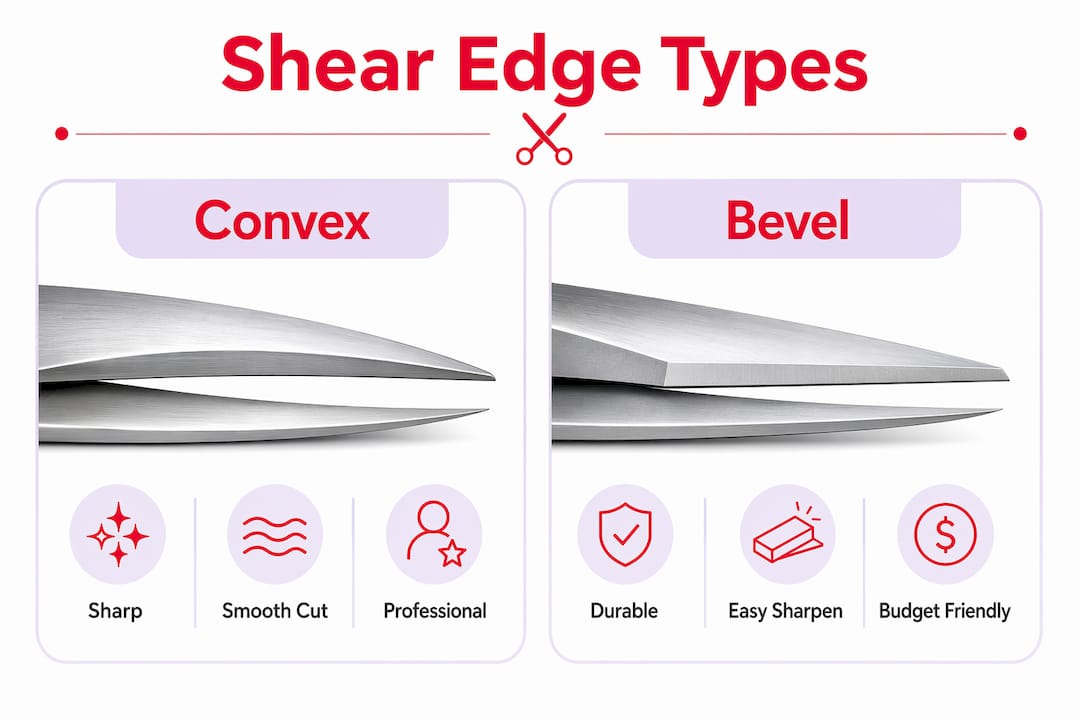
Convex edges are razor-sharp and ground to a fine, smooth angle. They slice through hair cleanly, which makes them the go-to for slide cutting, fade blending, and any technique where you want a seamless finish. The trade-off is they need more careful maintenance and sharpen more frequently under heavy use.
Bevel edges are ground at a steeper angle, which makes them tougher and more forgiving. They handle blunt cutting and scissor-over-comb work well, and they hold up better if you’re less meticulous about daily care. Most barbers starting out find bevel edges more forgiving.
When to add thinning or texturizing shears:
- Pair a 6.0–6.5" thinning shear with your main cutting shear for bulk reduction on thick or coarse hair
- Use texturizing shears (30–40 teeth) for blending and softening lines after a fade
- A 5.5–6.0" thinning shear works well alongside a 7.0" cutting shear for barbers who do both heavy bulk removal and finishing work in the same session
How to choose professional barber shears: a practical checklist
Buying shears online or in-store without a clear process leads to expensive mistakes. Here is a step-by-step sequence that works whether you are buying your first pro pair or upgrading.

1. Start with fit
Before steel grade or price, the shear has to fit your hand. Check handedness first. Then hold the shear in your cutting grip and check:
- Thumb ring sits at the first knuckle, not the second
- Fingers rest comfortably without forcing the hand open
- The shear feels balanced at the pivot, not tip-heavy
Avoid common buying errors like ordering based on length alone without accounting for ring size or handle geometry.
2. Read the steel specs
Steel grade tells you how long the edge lasts and how easy it is to sharpen. The industry standards for professional shears are:
- 440C: Reliable Japanese or German stainless, 58–61 HRC hardness, sharpens every 3–4 months under daily use. Good entry-to-mid-range choice.
- VG-10: Higher hardness (61–63 HRC), better wear resistance, holds an edge longer. Common in mid-to-premium shears.
- ATS-314 / ZA-18: Cobalt-enhanced Japanese alloys. Edge retention of 6–12 months under full-shift daily use versus 3–4 months for 440C. The standard for serious investment shears.
VG-10 at 61–63 HRC offers superior wear resistance and is used in premium shears where longevity justifies the higher upfront cost.
3. Check the tension system
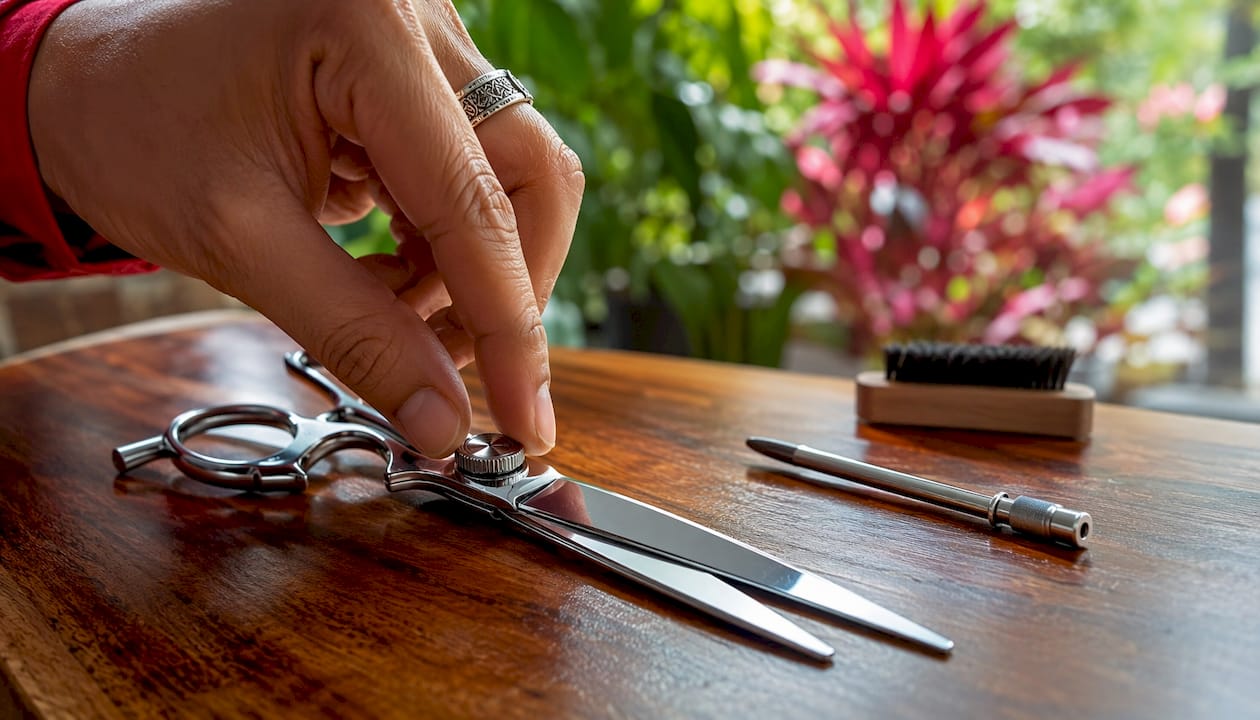
The pivot is what you feel on every single cut. Ball-bearing and dial tension systems deliver more consistent blade action than traditional fixed screws, which reduces hand fatigue during fast cutting sessions. A dial system lets you adjust tension mid-shift without tools. Fixed screws are fine for lower-volume work but can loosen or over-tighten unpredictably.
4. Price bands in CAD
| Tier | Approximate CAD range | What you get |
|---|---|---|
| Entry | $150–$250 | 440C steel, basic offset handle, functional for students and part-time barbers |
| Pro | $150–$400 | VG-10 or 440C, ergonomic handle options, better balance and finish |
| Premium | $400–$700 | ATS-314 or ZA-18, ball-bearing pivot, extended edge life, often with warranty |
Pro Tip: High-volume cutters may find premium steel cost-effective over time due to less frequent sharpening and reduced downtime. Fewer sharpenings, less downtime, and reduced hand fatigue add up faster than most barbers expect.
Always buy from authorised Canadian dealers and verify warranty and country of manufacture to avoid grey-market or counterfeit product.
How to keep your shears sharp and precise over years of use
A quality shear maintained properly will outlast a cheaper one by years. The difference is almost always in the daily habits.
Daily and weekly tasks
- After every shift: Wipe blades with a clean, dry cloth to remove hair, moisture, and product residue
- Daily: Apply one drop of shear oil to the pivot point and open and close the blades several times to distribute it
- Weekly: Check tension by holding the shear at the finger hole and letting the blade fall; it should stop at roughly 45 degrees, not slam shut or stay open
- Storage: Always store in a protective case or roll, never loose in a drawer
Pro Tip: Use shear-specific oil, not clipper oil or WD-40. The viscosity is different and the wrong lubricant can gum up the pivot or accelerate corrosion.
For a full maintenance routine for professional tools, including cleaning and lubrication steps, Salonbrandz has a practical guide worth bookmarking.
Sharpening intervals by steel grade
| Steel | Sharpening interval (daily full-shift use) | Signs it’s time |
|---|---|---|
| 440C | Every 3–4 months | Hair pulling, uneven cut, visible nicks |
| VG-10 | Every 4–6 months | Chatter on fine hair, inconsistent slide |
| ATS-314 / ZA-18 | Every 6–12 months | Reduced glide, hair folding instead of cutting |
When you send shears for sharpening, a qualified professional will check blade alignment, back-to-back blade seating, edge geometry, and pivot action. Ask specifically about those four points. In Canada, look for sharpeners who specialise in barber shears rather than general knife sharpeners. Many barber supply distributors, including Salonbrandz, can point you toward authorised service options.
When to replace instead of sharpen: A nick in the blade tip, a bent blade, or a cracked pivot housing means replacement. Resharpening cannot fix structural damage.
Ergonomic handle designs that protect your wrists and hands
Handle shape is the single most underrated spec in a shear purchase. Barbers who cut full shifts feel the difference within weeks.
Handle types and who they suit:
- Straight handle: Thumb and fingers aligned; traditional feel, higher wrist extension, better suited to stylists who prefer a classic grip
- Offset handle: Finger hole sits lower than the thumb ring, reducing wrist rotation; good for barbers transitioning from straight handles
- Semi-offset: A moderate angle between straight and offset; the most versatile choice for most barbers and the easiest to adapt to
- Crane/swivel handle: Maximum wrist relief; the thumb ring rotates or the handle drops significantly, letting the elbow stay lower during scissor-over-comb work
Offset and crane handles support natural hand positioning and reduce wrist extension, which is the key mechanical factor in repetitive strain injuries for full-time barbers.
Fit-test checklist before you commit
- Thumb sits at the first joint, not pushed through to the second
- Wrist stays in a neutral position (not bent up or down) during a simulated cutting motion
- The shear feels balanced at the pivot, not front-heavy
- Finger rings are not so large that the hand has to grip tightly to control the blade
- Silencer/bumper is present and absorbs blade contact without jarring the hand
Pro Tip: If you cut more than six hours a day, try alternating between a 6.5" and a 7.0" shear across your shift. Varying the grip and motion slightly reduces cumulative strain on the same tendons. Swivel-handle shears are particularly useful for the second half of a long shift.
Look for shears with removable thumb inserts or adjustable ring sizes. These let you fine-tune fit as your technique evolves or if your hand swells during a long shift.
Are expensive shears worth it for professional barbers?
The honest answer: it depends on your volume and how long you plan to stay in the trade.
Cost-versus-value breakdown:
- Longevity: Premium ATS-314 shears, properly maintained, can last 10–20 years. A $500 shear amortised over a decade costs less annually than replacing $150 shears every two years.
- Sharpening cadence: Cobalt-enhanced alloys need professional sharpening roughly half as often as 440C under the same workload. Over three years, that is a meaningful difference in downtime and service cost.
- Ergonomics: Better-balanced shears with quality pivot systems reduce hand fatigue. Reduced fatigue means fewer errors late in a shift and lower long-term injury risk.
- Resale value: Premium Japanese shears from recognised makers hold value. A well-maintained ATS-314 shear can be resold at a reasonable fraction of its original price.
Investing in quality steel and ergonomic design reduces long-term ownership cost by extending intervals between professional sharpening and reducing injury-related downtime.
When a mid-range shear is enough: If you are a student, a part-time barber, or still developing your technique, a solid 440C shear in the $150–$250 CAD range is the right call. Spending $600 on premium steel before your cutting style is settled is premature. For affordable salon essentials that hold up to professional use, there are good options at the pro-tier price point.
When premium is justified: Full-time barbers cutting 30+ clients per week, anyone with existing wrist or elbow strain, and barbers who want a single pair that lasts their career. The ergonomic and edge-retention advantages compound over years of daily use.
Final recommendation and buying workflow for Canadian barbers
The verdict: a 6.5–7.0" convex-edge shear in ATS-314 or VG-10 steel with a semi-offset or crane handle is the right choice for most professional barbers in Canada. It covers the widest range of barbering tasks, holds its edge through a full week of heavy use, and protects your hands over a long career.
Three-step buying process:
- Fit test first. Hold the shear in your cutting grip, check thumb position and wrist angle, and confirm the balance feels right at the pivot. If buying online, check the return or exchange policy before ordering.
- Verify steel and specs. Confirm the steel grade (ATS-314, VG-10, or 440C), blade edge type (convex or bevel), and tension system (dial or ball-bearing preferred for high volume). Cross-reference the manufacturer’s country of origin.
- Buy from an authorised Canadian source. Salonbrandz carries professional shears and ships across Canada, with in-store pickup available in Scarborough. Buying locally means warranty support is straightforward and you are not navigating cross-border returns.
What to confirm before checkout:
- Correct length for your primary technique (6.5" or 7.0" for most barbers)
- Handedness (right or left)
- Steel grade matches your volume and budget
- Warranty terms are clearly stated
For a complete look at building your barber setup beyond shears, Salonbrandz has a practical guide covering complementary tools and workflow.
Key takeaways
The most effective shear for full-time Canadian barbers is a 6.5–7.0" convex-edge model in ATS-314 or VG-10 steel with a semi-offset or crane handle, bought from an authorised Canadian supplier with clear warranty terms.
| Point | Details |
|---|---|
| Recommended size and edge | A 6.5–7.0" convex-edge shear covers scissor-over-comb, fades, and bulk removal for most barbers. |
| Steel grade matters | ATS-314 and VG-10 hold their edge for 6–12 months under daily use; 440C needs sharpening every 3–4 months. |
| Handle shape protects your wrists | Semi-offset or crane handles reduce wrist extension and cumulative strain over full-shift cutting. |
| Sharpen on schedule | Match your sharpening cadence to your steel grade; hair pulling or uneven cuts mean it’s overdue. |
| Buy from Salonbrandz | Salonbrandz ships professional shears across Canada with in-store pickup in Scarborough near Toronto. |
What actually matters when you buy shears
Most barbers overthink steel grade and underthink handle fit. The sharpest blade in the world does not help you if the handle forces your wrist into an awkward angle for eight hours straight. I have seen barbers spend $600 on premium Japanese steel and then develop elbow pain within six months because the handle geometry was wrong for their grip.
The other thing worth saying plainly: the Canadian market has a real counterfeit and grey-market problem with premium shears. A $400 shear sold through an unverified channel with no warranty documentation is not a deal. It is a risk. Buying from a supplier who can confirm authorised distribution and back the product with a real warranty is not a premium, it is basic protection for a tool you depend on every working day.
The recommendation in this article is not complicated: get the right length for your primary technique, match the steel grade to your volume, fit-test the handle before you commit, and buy from a source that stands behind what it sells. That is it.
Professional shears, shipped across Canada

Salonbrandz is a Canadian supplier of professional salon and barber tools, carrying shears and equipment from trusted brands across more than 75 product lines. Every order ships across Canada, and if you are in the Greater Toronto Area, in-store pickup is available at the Scarborough location.
Why barbers order from Salonbrandz:
- Canadian shipping with no cross-border complications or customs delays
- In-store pickup in Scarborough for same-day access
- Pro pricing options available through the pro access registration
- Warranty support handled locally, not through overseas manufacturers
Whether you are buying your first professional pair or replacing a worn-out workhorse, shop professional shears at Salonbrandz and get the right tool with the backing of a Canadian supplier who knows the trade.
Further reading and authoritative sources
- Scissor Warrior: Best Barber Shears Guide — Covers shear length recommendations, blade edge types, and steel grades for professional barbers
- Saki Shears: Precision Hair Cutting Shear — Detailed steel grade comparisons and sharpening interval data for ATS-314 and 440C
- Matakki: Tension System Overview — Explains ball-bearing and dial tension systems and their effect on cutting performance
- Kamisori Shears: Ergonomic Guidance — Handle type comparisons and wrist-strain reduction for full-time barbers
- Japan Scissors USA: Authenticity and Warranty Notes — Guidance on buying from authorised distributors and avoiding counterfeit shears
- Salonbrandz: Professional Salon Supplies Canada — Canadian supplier for professional shears, tools, and salon equipment with coast-to-coast shipping


