


Ceramic vs titanium flat iron: which suits your hair?
For fine, colour-treated, or damaged hair, choose ceramic. For thick, coarse, or stubborn hair that resists straightening, choose titanium. That is the short answer and it holds across most professional contexts.
The reasoning comes down to how each material moves heat into your hair. Ceramic plates emit far-infrared heat, warming the hair shaft from the inside out at a gentler, more even temperature. Titanium heats the surface fast and hard. Both approaches work, but they work for different hair. Salonbrandz stocks both plate types from professional-grade brands including BaBylissPRO, so Canadian buyers can find the right tool without hunting across multiple retailers.
Quick picks by hair type:
- Fine, thin, or fragile hair: ceramic, set to a low effective temperature
- Colour-treated or chemically processed hair: ceramic, at safe moderate heat levels
- Normal or medium-density hair: either material works; ceramic is safer for daily use
- Thick, coarse, or very curly hair: titanium, set to a high effective temperature
- Stubborn frizz or natural hair: titanium with adjustable settings
The Good Housekeeping Institute consistently flags adjustable temperature as the single most important feature in any flat iron, regardless of plate material.
Table of Contents
- How ceramic and titanium plates actually heat your hair differently
- Why ceramic plates are the safer choice for most home users
- Why titanium is the professional’s choice for speed and thick hair
- Which flat iron material matches your hair type and styling goal?
- How to avoid heat damage with either plate material
- What to look for when buying a flat iron in Canada
- What stylists actually use and what industry testing shows
- Key takeaways
- A straight opinion on what actually matters
- Pro-grade flat irons available through Salonbrandz in Canada
- Useful sources and further reading
How ceramic and titanium plates actually heat your hair differently
Ceramic plates use infrared technology to heat hair from the inside of the shaft outward. The result is a slower, more gradual heat transfer that is measurably gentler on the cuticle. Ceramic irons can maintain very consistent heat across the plate surface, which means fewer hot spots and more predictable results.
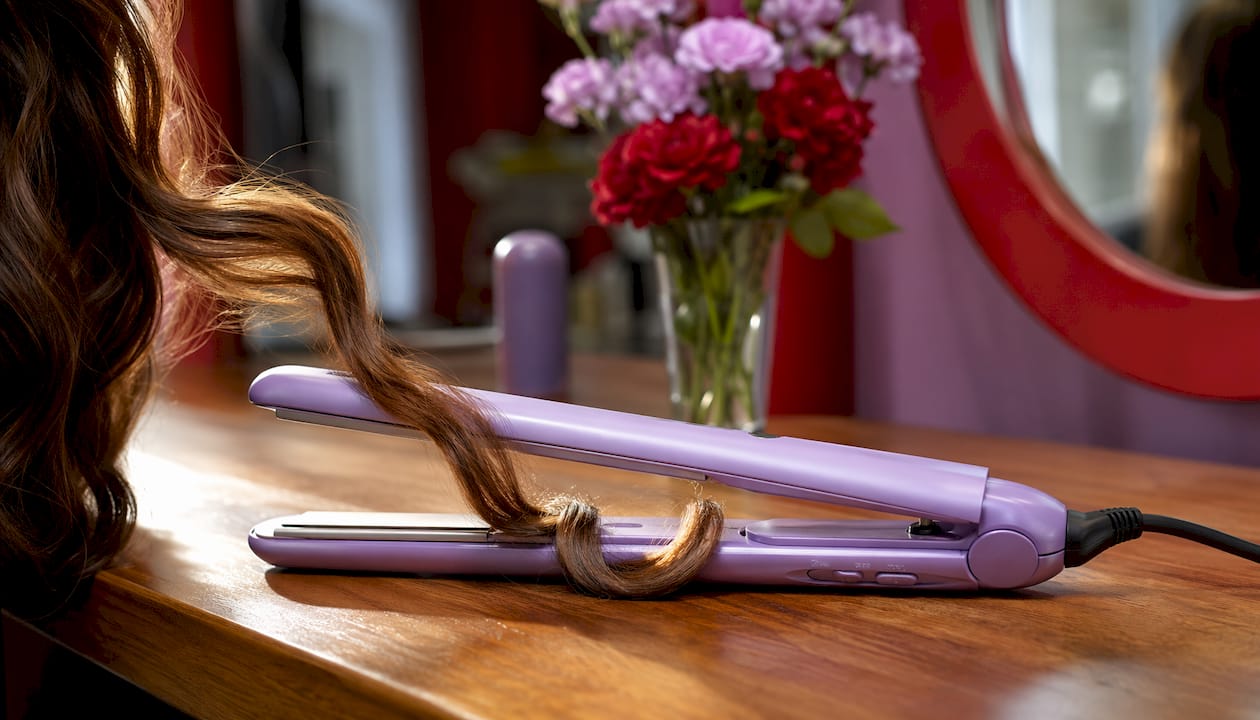
Titanium conducts heat at the surface of the hair shaft and does it very quickly. Titanium plates can reach high temperature much faster than solid ceramic plates that typically take longer to heat up. That speed is genuinely useful for thick hair that would otherwise require multiple slow passes, but it also means the margin for error is smaller.
One construction detail matters a lot here: many irons sold as “ceramic” actually use a ceramic coating over an aluminium base. Consumer testing shows that coating wear can lead to plate chipping, exposing the metal underneath and creating uneven heat distribution. Solid ceramic plates cost more but behave consistently throughout the life of the tool. When you are comparing models, ask specifically whether the plates are solid ceramic or ceramic-coated.
Stat to know: Titanium reaches 450°F in under 15 seconds. Most solid ceramic models take 30–45 seconds. That gap matters on thick hair but is irrelevant on fine hair where you should never approach 450°F anyway.
Pro Tip: If you are shopping for a ceramic iron, look for “full ceramic” or “solid ceramic” in the product description. “Ceramic-coated” is a different product with a shorter effective lifespan.
Why ceramic plates are the safer choice for most home users
Ceramic is forgiving. It heats evenly, it does not spike, and it is far less likely to scorch a section of hair if you pause mid-pass. For anyone styling fine, damaged, or colour-treated hair at home, that consistency is worth more than raw heat speed.
Ceramic strengths:
- Even heat distribution with minimal hot-spot risk
- Infrared heat that works from inside the shaft, reducing surface damage
- Better moisture retention after styling, leaving hair smoother and less frizzy
- Safer for daily use at lower temperatures
- Generally more affordable than titanium at equivalent quality levels
Ceramic drawbacks:
- Slower heat-up time than titanium (30–45 seconds for solid ceramic)
- Ceramic-coated models can chip and wear over time
- May require more passes on very thick or coarse hair, which can offset the gentleness benefit
Choose ceramic if your hair is:
- Fine or thin
- Colour-treated or bleached
- Chemically relaxed or permed
- Dry, brittle, or prone to breakage
- Styled daily at lower heat settings
BaBylissPRO offers ceramic flat iron options with adjustable temperature controls and solid plate construction, which is the combination that makes ceramic genuinely protective rather than just marketed that way.
Why titanium is the professional’s choice for speed and thick hair
Titanium is fast, runs hot, and stays hot. For a stylist working through back-to-back clients with thick, resistant hair, those three things are the whole argument. For a home user with coarse or very curly hair who wants results in fewer passes, the same logic applies.
Titanium strengths:
- Heats to full temperature in under 15 seconds
- Instant heat recovery between passes, no waiting between sections
- Lightweight plates that glide more easily through dense hair
- Highly durable and resistant to corrosion with regular use
- Reaches temperatures that genuinely penetrate thick, coarse strands
Titanium drawbacks:
- High surface heat creates a real damage risk on fine or chemically treated hair
- Less forgiving if you pause or slow down mid-pass
- Can overheat quickly if the temperature is not matched to hair type
Choose titanium if your hair is:
- Thick, dense, or coarse
- Very curly or coily and resistant to straightening
- Healthy and not chemically processed
- Styled less frequently but requiring fast, one-pass results
Using high heat on fine or chemically treated hair with a titanium iron is one of the most common causes of severe, immediate heat damage. It is often mistaken for inevitable wear, but the right temperature and a heat protectant prevent most of it.
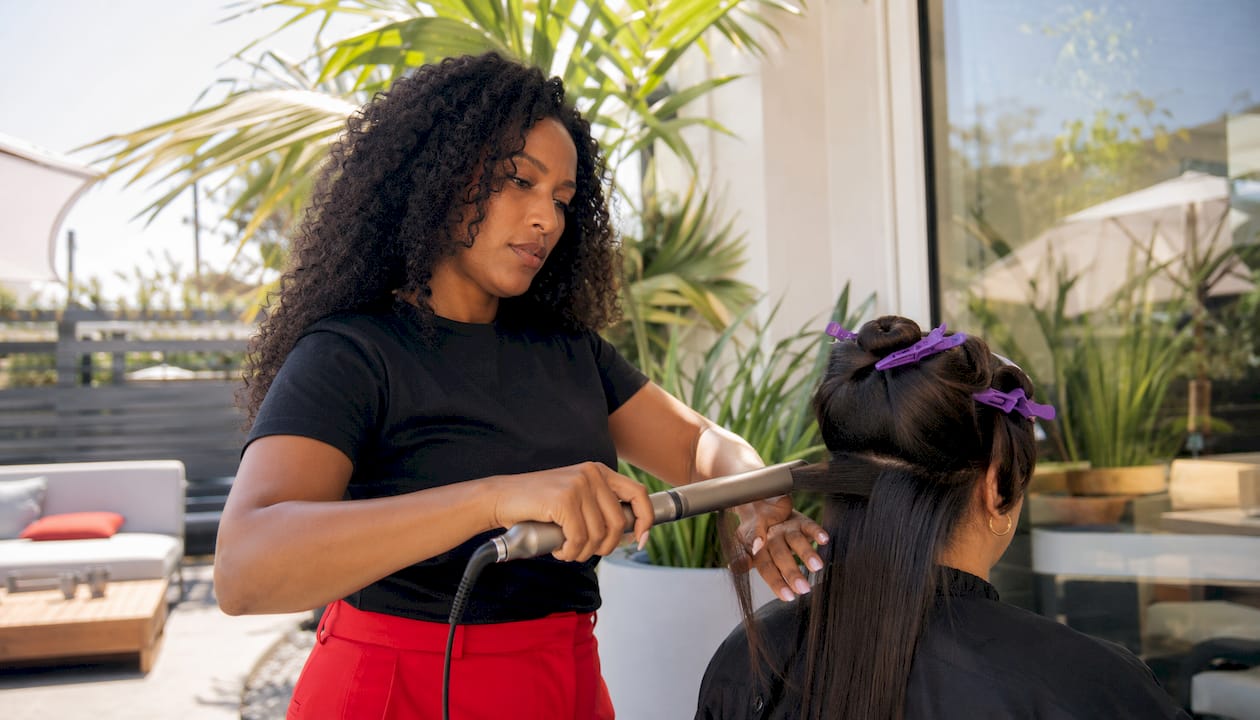
Pro Tip: Never set a titanium iron to its maximum temperature just because the dial goes there. Match the setting to your hair’s actual resilience. Thick, healthy hair can handle 400°F–430°F; fine or treated hair should stay under 350°F regardless of plate material.
Which flat iron material matches your hair type and styling goal?
The table below maps hair type to plate material, temperature range, and plate width. These are the ranges professional stylists use as starting points, not hard ceilings.
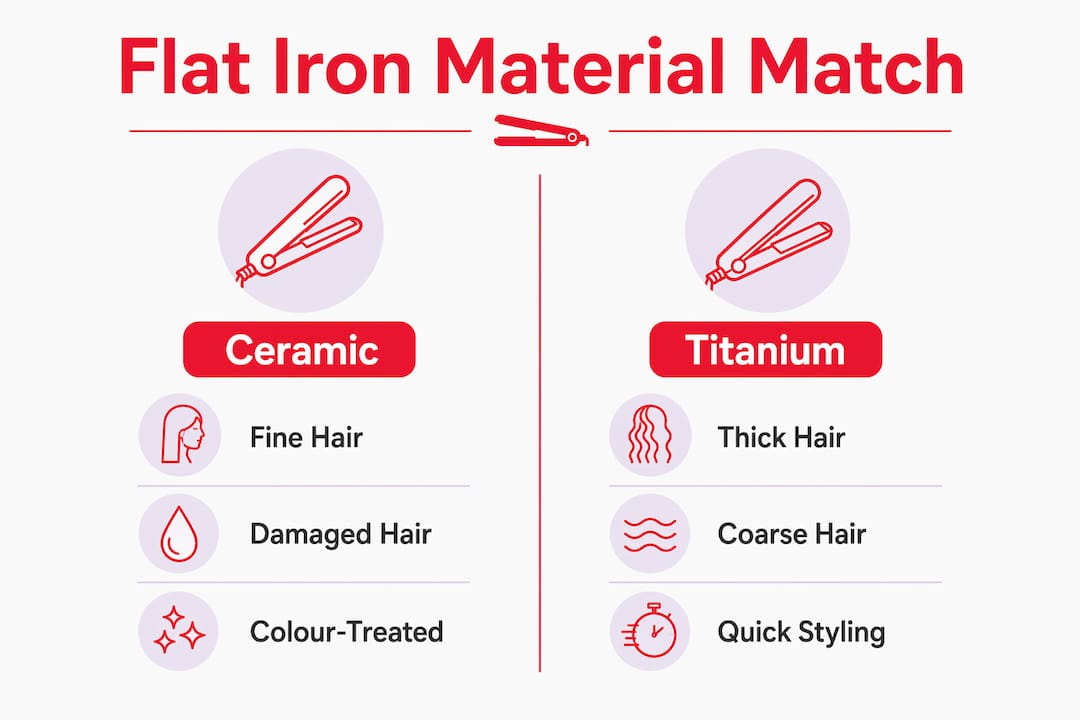
| Hair type | Recommended material | Temperature range | Plate width |
|---|---|---|---|
| Fine / thin | Ceramic | Low to moderate heat | Narrow plates for control |
| Normal / medium | Ceramic or titanium | Moderate heat levels | Medium-width plates |
| Thick / coarse | Titanium | High heat levels | Wider plates for larger sections |
| Very curly / coily | Titanium | High heat levels suitable for dense hair | Medium to wide plates |
| Colour-treated | Ceramic | Low to moderate heat | Medium-width plates |
| Dry or damaged | Ceramic | Low heat | Medium-width plates |
On plate width: wider plates (1.25’‘–2’') create more tension and smooth larger sections faster, which is useful for long or thick hair. Narrow plates (0.5’‘–1’') give you more control for short hair, fringes, or detail work around the face.
Finish expectations by material:
- Ceramic tends to produce a softer, more natural-looking straight with visible shine
- Titanium delivers a sleeker, more polished finish with higher tension
Passes per material:
- Ceramic on fine hair: one slow pass per section is usually enough
- Ceramic on thick hair: two to three passes, which can extend styling time
- Titanium on thick hair: one to two passes at the right temperature
- Titanium on fine hair: one very careful pass at a reduced temperature, ideally with a heat protectant buffer
For colour-treated hair, pairing the right flat iron with a colour-safe hair care routine extends both the colour and the health of the hair between appointments.
How to avoid heat damage with either plate material
The safest approach with any flat iron is adjustable temperature, starting low, a maximum of one to two passes per section, and a heat protectant applied before you touch the iron to your hair. That combination prevents the vast majority of avoidable damage regardless of plate material.
Safe straightening routine:
- Start with completely dry hair. Never use a flat iron on wet or damp hair.
- Section hair into manageable layers, working from the bottom up.
- Apply a heat protectant evenly through each section before styling.
- Set the temperature appropriate to your hair type (see the table above).
- Take a single slow pass through each section, keeping the iron moving.
- Allow each section to cool before touching or brushing it.
- Finish with a light serum or oil to seal the cuticle.
Dos and don’ts:
- Do start at the lowest effective temperature and increase only if needed
- Do inspect ceramic plates regularly for chips or uneven coating wear
- Do use a heat protectant every single time, not just occasionally
- Do not make repeated high-heat passes over the same section
- Do not use a flat iron on hair that is not fully dry
- Do not set titanium irons to maximum heat unless your hair genuinely requires it
Tests cited by FIFN report a 47% lower breakage rate after 90 days of daily ceramic use compared to higher-heat metals when no heat protectant was used. Colour fade was 38% greater with titanium at identical temperatures. Those numbers make the case for both ceramic and heat protectant more clearly than any marketing claim.
Pro Tip: Check your ceramic plates every few months. Run your fingernail lightly across the surface. Any roughness, flaking, or visible chips means the coating is compromised. A chipped ceramic plate can snag and break hair far more aggressively than a titanium plate at the same temperature.
What to look for when buying a flat iron in Canada
Prioritise adjustable temperature, true plate material (solid ceramic versus ceramic-coated versus titanium), plate width suited to your hair, and warranty service available in Canada. Those four factors separate a tool that lasts from one that disappoints within a year.
Features checklist:
- Digital temperature control with a wide range (200°F–450°F covers all hair types)
- Swivel cord of at least 8 feet for comfortable manoeuvring
- Auto shut-off (30–60 minutes) for safety
- Dual voltage (100–240V) if you travel internationally
- Plate width matched to your hair length and density
Price brackets and what to expect:
- Budget (under $50 CAD): ceramic-coated plates, limited temperature range, shorter cord, no dual voltage
- Mid-range ($50–$150 CAD): wider temperature range, better plate quality, some solid ceramic options, swivel cord
- Professional ($150 CAD and up): solid ceramic or full titanium plates, precise digital controls, dual voltage, longer warranty, faster heat-up
Good Housekeeping Institute testing confirms that professional tools commonly offer ranges from 200°F to 450°F, and stylists consistently advise against using maximum heat unless the hair texture genuinely requires it.
Worth knowing: Some newer professional irons now include adaptive heat sensors that monitor hair movement and adjust temperature dynamically, reducing damage risk on mixed-density hair.
Pro Tip: For Canadian buyers, check whether the warranty is honoured in Canada or only through a US service centre. A two-year warranty with Canadian service is worth more than a three-year warranty you cannot practically use.
Salonbrandz carries professional BaBylissPRO tools with Canadian warranty support, and ships across Canada with in-store pickup available in Scarborough.
What stylists actually use and what industry testing shows
Professionals tend to own both. Titanium for fast, back-to-back clients with thick or resistant hair; ceramic for colour work, gentler repeat services, and clients with fragile or chemically treated hair. That split is not indecision. It reflects the fact that no single plate material is optimal across every hair type and service.
Testing by the Good Housekeeping Institute and editorial reviews from Allure and Byrdie consistently show that no single plate material universally outperforms others across all hair types. Engineering quality and correct use are the main determinants of long-term hair health, not the material label on the box.
Forbes stylist recommendations emphasise that the iron allowing the most precise temperature control often matters more than plate material alone. A well-engineered ceramic iron with a wide temperature range will outperform a poorly calibrated titanium iron on almost any hair type.
On efficiency: ceramic irons in long-term editorial tests show reduced breakage and less colour fade compared to higher-heat metals used at the same temperature setting. Titanium’s advantage is speed and heat recovery. Titanium recovers heat almost instantly between passes, making it genuinely superior for continuous, rapid styling in a salon environment where downtime between sections adds up.
Pro Tip: If you alternate between colour work and general straightening services, or between fine and thick clients, owning both a titanium and a ceramic iron is the practical solution. Use titanium for quick, one-pass jobs and ceramic for colour work and gentler daily styling.
Plate maintenance in professional settings is straightforward: wipe plates with a damp cloth after each use once the iron has cooled, and never use abrasive cleaners on ceramic surfaces. For titanium, a light wipe removes product build-up without risk of surface damage.
Key takeaways
Ceramic suits fine, colour-treated, and damaged hair with gentler infrared heat; titanium suits thick, coarse, or stubborn hair that needs fast, high-heat passes.
| Point | Details |
|---|---|
| Match material to hair type | Ceramic for fine, damaged, or colour-treated hair; titanium for thick, coarse, or very curly hair. |
| Adjustable temperature is non-negotiable | Start at the lowest effective setting; professional tools range from 200°F to 450°F. |
| Check plate construction | Solid ceramic outperforms ceramic-coated; coated plates chip and create uneven heat over time. |
| Always use a heat protectant | FIFN-cited tests show 47% lower breakage with ceramic and no protectant vs. higher-heat metals; protectant reduces risk further. |
| Salonbrandz for Canadian buyers | Salonbrandz stocks pro-grade ceramic and titanium flat irons with shipping across Canada and in-store pickup in Scarborough. |
A straight opinion on what actually matters
The ceramic versus titanium debate gets more attention than it deserves when the real question is whether the iron has precise temperature control and whether you are using it correctly for your hair.
Most heat damage does not come from the wrong plate material. It comes from using too much heat, too many passes, and no protectant. A titanium iron set to 350°F with a good heat protectant is safer on fine hair than a ceramic iron cranked to 430°F with nothing on it. The material shapes the risk profile, but your settings and technique determine the outcome.
The one place where material genuinely changes the calculus is for colour-treated or chemically processed hair used daily. Ceramic’s infrared approach and lower hot-spot risk make a measurable difference over weeks and months of repeated use. For that specific case, the material choice is not just a preference. It is the right call.
For everyone else, buy the iron with the widest adjustable temperature range you can afford, confirm it has solid plates rather than a coating, and learn your hair’s actual heat tolerance before you touch the maximum setting.
Pro-grade flat irons available through Salonbrandz in Canada
If you want professional-grade ceramic or titanium flat irons without ordering from a US retailer and navigating warranty headaches, Salonbrandz is the straightforward Canadian option.
Salonbrandz stocks both plate types from trusted professional brands including BaBylissPRO, with shipping across Canada and in-store pickup in Scarborough near Toronto. Whether you need a solid ceramic iron for daily colour-safe styling or a titanium iron built for thick, resistant hair, the inventory covers both ends of the spectrum at professional quality levels. Pricing spans mid-range to pro-grade, and all products come with Canadian-applicable warranty support.
Browse the full range of professional salon tools at Salonbrandz, or contact the team directly for a recommendation matched to your hair type and styling routine.
Useful sources and further reading
| Source | What it covers |
|---|---|
| FIFN: Ceramic vs Titanium Guide | Heat consistency data, breakage and colour-fade test results |
| Evalectric: Ceramic vs Titanium Flat Irons | Titanium heat-up speed, heat recovery, and professional use cases |
| Good Housekeeping Institute | Tested flat irons, temperature range guidance, adjustable heat recommendations |
| NBC News Select: Best Flat Irons | Ceramic coating wear, engineering quality vs. material claims |
| Byrdie: Best Hair Straighteners | Plate width guidance and styling speed data |
| Forbes Vetted: Best Hair Straighteners | Stylist temperature control recommendations |
| Ulta Beauty: Titanium vs Ceramic | Hair-type matching guide and heat distribution comparison |
| Salonbrandz | Canadian availability, BaBylissPRO inventory, shipping and pickup options |


