


Cream developer vs liquid: which one should you use?
Use cream developer for root touch-ups, resistant grey, and precision work. Use liquid developer when you need fast, uniform saturation across long hair or are working with a bottle system. That is the short answer. The longer one is worth reading before you mix anything.
The chemistry is identical at equal volumes. A 20 vol cream developer and a 20 vol liquid developer both contain 6% hydrogen peroxide — the same oxidising strength, the same lift potential. What changes is everything around the peroxide: the thickeners, emulsifiers, conditioning agents, and buffers that give cream its body, versus the near-water fluidity of a liquid formula. Those additives do not change how much the colour lifts. They change where it stays, how long it holds contact, and how forgiving the mix is when your timing or ratio drifts slightly.
Quick-reference guide:
- Root touch-up or resistant grey? Reach for cream. Its density holds the mix against vertical roots long enough for full oxidation.
- All-over colour on long or textured hair? Liquid moves faster, distributes more evenly, and works well in a bottle applicator.
Salonbrandz carries professional developer formats for both applications and ships across Canada, with in-store pickup available in Scarborough.
Table of Contents
- Does cream developer actually lift differently than liquid?
- How does texture actually change your colour result?
- When should you use cream developer?
- When does liquid developer give you better results?
- Mixing and application: ratios, tools, timing, and what goes wrong
- How to decide: a quick diagnostic checklist
- What to look for on labels and where to buy in Canada
- How long does developer last, and how should you store it?
- Safety precautions for cream and liquid developers
- Environmental impact and disposal of cream and liquid developers
- Key takeaways
- The form you choose matters more than most people think
- Professional developers for Canadian stylists and at-home colourists
Does cream developer actually lift differently than liquid?
No — and this is the most important thing to get straight before anything else. At the same volume, cream and liquid developers contain the same percentage of hydrogen peroxide: 20 vol equals 6% H2O2 regardless of form. Choosing cream over liquid does not give you more or less lift. The volume number is the only thing that determines oxidising strength.
What the two forms do differently comes down to their ingredient lists:
- Cream developers contain thickeners (such as cetyl or stearyl alcohol), emulsifiers, conditioning agents, and buffering compounds like pyrophosphate. These raise viscosity, soften the pH slightly, and add a mild conditioning effect to the mix.
- Liquid developers are primarily water and hydrogen peroxide. The result is a thin, fast-moving formula with higher yield per bottle and no added conditioning benefit.
The practical consequences matter. Cream’s conditioning agents and buffers make it gentler on fine or previously processed hair, and cream developers are often recommended for fine, colour-treated hair precisely because they allow better control and reduce the risk of over-saturation. Liquid’s thinner consistency means it penetrates porous fibre quickly and distributes across a large surface area with less effort — useful properties, but ones that require tighter technique to control.
Pro Tip: Before swapping developer forms within a colour line, check the brand’s technical data sheet. Some formulas are calibrated for a specific developer consistency, and switching forms without checking can alter viscosity, processing time, and final result.
How does texture actually change your colour result?
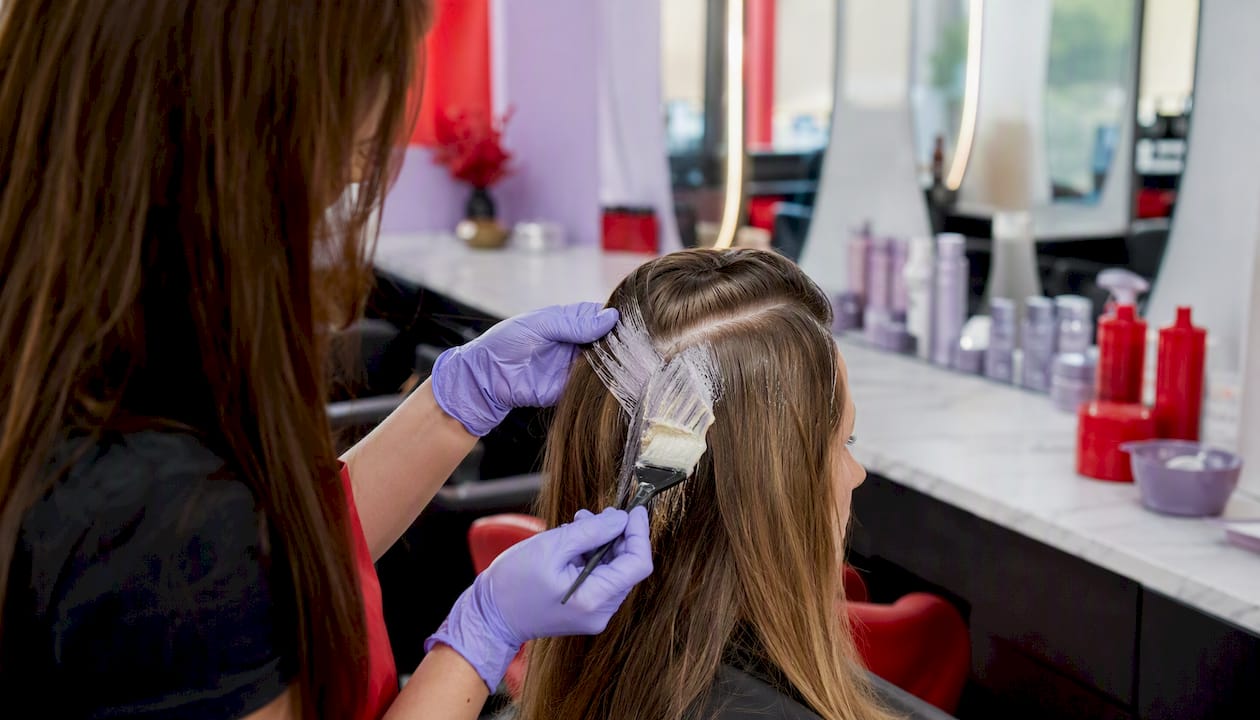
Viscosity is not just a handling preference — it directly affects contact time, and contact time is what determines whether resistant grey actually covers.
A dense cream mix holds against vertical roots under gravity. A liquid mix can run down the shaft within minutes of application, pulling the active formula away from the root zone before oxidation is complete. On a seated client with roots pointing upward, that difference can mean the gap between full coverage and a patchy result.
Here is how the two forms behave in practice:
- Cream on resistant grey: Stays put. Maintains consistent contact across the root band. Oxidation proceeds evenly, which is why grey coverage is more reliable.
- Liquid on resistant grey: Can migrate toward the ends, thinning the concentration at the root. The result may look lighter or less saturated at the scalp than intended.
- Perceived lift speed: Liquid can feel like it works faster because it penetrates porous fibre quickly. The actual chemical lift at the same volume is equivalent — the sensation of speed comes from faster initial penetration, not stronger oxidation.
- Saturation on long hair: Liquid wins here. It moves through dense or textured hair with less manual effort and reaches mid-lengths and ends more uniformly.
Cream is also a more forgiving buffer when ratios or timing drift slightly. If you are slightly off on your mix or get interrupted mid-service, cream holds its consistency longer than liquid, which thins out faster as ratios shift.
Pro Tip: If you are working with a liquid mix on vertical roots, use a controlled pour rather than a free flow, work in thin sections, and check the root zone every five minutes. Repositioning the client slightly forward can also help keep the mix from running.
When should you use cream developer?
Cream developer is the right choice whenever placement precision and contact time matter more than speed of distribution.
- Resistant grey coverage: The density keeps the mix at the root long enough for full oxidation. This is the single strongest argument for cream on grey hair.
- Root touch-ups: Bowl-and-brush application with a cream mix gives you clean sectioning and controlled placement right at the regrowth line without flooding the previously coloured lengths.
- Precision highlights and balayage: Cream stays where you paint it. On foil work or freehand sections, that predictability prevents bleed and keeps the lift zone clean.
- Fine or previously processed hair: The conditioning agents in cream developers are gentler on compromised cuticles. For demi-permanent services on fragile hair, cream reduces the risk of over-saturation.
- Slow, consistent processing: When you need the formula to process evenly across a section over 30–45 minutes, cream’s stability is an advantage over a mix that can thin and shift.
For bowl-and-brush application, mix in a non-metallic bowl, apply with a colour brush in clean sections, and work from the root outward. Processing time should follow the brand’s tech sheet — not a general rule of thumb.
Pro Tip: On a seated client, gravity works against you at the root. Cream’s density compensates for this naturally. If you are working on a client who cannot sit fully upright, cream is especially worth choosing over liquid.

When does liquid developer give you better results?
Liquid developer earns its place in specific workflows where fluidity is an advantage rather than a liability.
- All-over colour on long or dense hair: Liquid distributes through the full length quickly and evenly. Trying to saturate long hair with a thick cream mix takes significantly more product and effort.
- Bottle applicator systems: Many at-home and professional bottle tools are designed for a thinner mix. Cream can clog the nozzle or apply unevenly when squeezed through a narrow tip.
- Semi-permanent and gloss services: These low-volume applications (5–10 vol) are deposit-only and do not require the adhesion properties of cream. Liquid works well here.
- Quick saturation on porous hair: Highly porous hair absorbs liquid developer rapidly and evenly, making it efficient for refresh or toning services.
- Higher product yield: Because liquid is thinner, you get more coverage per millilitre compared with a cream mix of the same volume.
The main caution with liquid is technique discipline. Liquid developer is primarily water and hydrogen peroxide, which means the mix thins out quickly if ratios are not followed precisely. On vertical roots, the running risk is real.
Liquid developer rewards a confident, fast applicator. If your sectioning is clean and your timing is tight, it is an efficient tool. If you are still building your technique, cream gives you more margin to work with.
Mixing and application: ratios, tools, timing, and what goes wrong
Getting the mix right is where most colour mistakes actually happen — not in the choice of volume or brand.
Step-by-step mixing and application
- Read the tech sheet first. Confirm the recommended developer form (cream or liquid), the mixing ratio, and the processing time for your specific colour line.
- Measure by weight, not volume. A kitchen or postal scale gives more accurate ratios than eyeballing in a bowl.
- Prepare your sections before you mix. Once the developer is combined with colour, the clock starts.
- Apply to the target zone first — roots for regrowth, mid-lengths and ends for all-over services.
- Set a timer and check the root zone at the midpoint of the recommended processing time.
- Strand test before any new formula, new developer brand, or significant change in hair condition.
Tools and packaging
- Bowl and brush: Best with cream developer. Gives you control over placement and lets you see the mix consistency before you apply.
- Bottle applicator: Better suited to liquid developer. Faster for all-over services, but requires clean sectioning to avoid uneven saturation.
Volume reference
Developer volumes map to lift levels: 5–10 vol for deposit and minimal lift (demi-permanent), 20 vol (6% H2O2) for standard permanent services and grey coverage, 30–40 vol for stronger lift and lightening. Choosing an excessively high volume damages the cuticle — prefer lower volume with controlled timing over forcing a faster lift with a higher strength.
Common mistakes
- Swapping cream for liquid (or vice versa) without checking the brand’s tech sheet
- Mixing too runny by adding extra liquid to a cream formula to make it easier to apply
- Assuming 30 vol lifts better than 20 vol in all cases — it lifts more aggressively, but also damages more
- Skipping the strand test on previously coloured or chemically treated hair
Pro Tip: If you are using a liquid developer in a root service and the mix starts running, slow down your pour, work in smaller sections, and increase your check-in frequency. Do not compensate by adding more product — that changes the ratio.
How to decide: a quick diagnostic checklist
Before you reach for either bottle, run through these questions:
- Is the root vertical and resistant to colour? Yes → cream developer. Its density maintains contact time where it counts.
- Is this a precision service (root touch-up, highlights, balayage)? Yes → cream, bowl and brush.
- Is this an all-over service on long or dense hair? Yes → liquid, bottle applicator.
- Does the colour line specify a developer form? Always follow the brand’s recommendation first.
- Is the hair fine, fragile, or previously processed? Cream’s conditioning agents offer more protection.
- Are you using a bottle tool? Liquid is the practical choice for bottle systems.
- Is speed and uniform saturation the priority? Liquid.
| Scenario | Recommended form | Key action |
|---|---|---|
| Resistant grey, vertical roots | Cream | Strand test; check contact at midpoint |
| Root touch-up, regrowth | Cream | Bowl and brush; follow brand ratio |
| All-over colour, long hair | Liquid | Bottle applicator; clean sections |
| Semi-permanent / gloss | Liquid | 5–10 vol; confirm brand tech sheet |
| Fine or colour-treated hair | Cream | Lower volume; check processing time |
What to look for on labels and where to buy in Canada
Reading a developer label carefully before you buy saves a service call later. Look for:
- Volume (strength): Clearly stated as 5, 10, 20, 30, or 40 vol. This is the most important number on the label.
- Form: Cream or liquid — sometimes labelled as “crème,” “oxidant,” or “activator.” If it is not clear, check the product data sheet.
- pH range: Lower pH (around 3–4) is gentler; some cream developers list this.
- Pack size: Professional sizes (500 ml, 1000 ml) offer better value for salon use. Single-use sachets are available for at-home applications.
- Expiry and storage: Most developers carry a shelf-life date. Check it before purchasing in bulk.
In Canada, professional developers are typically sold through licensed beauty supply distributors rather than general retail. Always check the colour line’s technical data sheet for recommended developer form and ratio before switching forms — this applies whether you are buying online or in store.
Salonbrandz carries professional developer formats with clear product spec pages, making it straightforward to compare pack sizes and confirm the right form before you order. In-store pickup is available in Scarborough for faster access when you need product the same day.
Before purchasing any developer in Canada, confirm the product is intended for professional use and that the volume matches your service. When in doubt, consult the colour line’s technical data sheet or speak with a supplier who stocks the full product range.
How long does developer last, and how should you store it?
Opened developer degrades faster than most people expect. Hydrogen peroxide breaks down on contact with air, light, and heat — and once that process starts, the developer loses oxidising strength.
Cream developer typically has a slightly longer working life after opening than liquid, partly because its thicker consistency limits surface exposure to air. An opened cream developer stored correctly (sealed, cool, dark) can remain effective for up to 6 months, though many manufacturers recommend using it within 3 months of opening.
Liquid developer is more vulnerable to degradation once opened. Its thinner consistency means more surface area is exposed to air, and the peroxide breaks down faster. Use opened liquid developer within 6–8 weeks when possible.
General storage rules for both forms:
- Store in a cool, dark location away from direct sunlight and heat sources.
- Keep the cap tightly sealed after every use.
- Never store in a metal container — hydrogen peroxide reacts with metal.
- Do not mix leftover developer back into the original bottle.
- Check the colour of the liquid before use: yellowing or a strong chemical smell indicates degradation.
Buying in a pack size that matches your actual usage rate matters here. A 1000 ml bottle is economical for a busy salon but wasteful for occasional at-home use.
Safety precautions for cream and liquid developers
Both forms contain hydrogen peroxide and carry the same core safety considerations, but their different textures create slightly different risk profiles.
For both forms:
- Wear gloves during mixing and application. Hydrogen peroxide irritates skin with prolonged contact.
- Avoid contact with eyes. If contact occurs, rinse immediately with water for at least 15 minutes.
- Do not apply to broken, irritated, or sunburned scalp.
- Never apply developer to hair without colour or lightener — developer alone causes uncontrolled lift and significant damage.
- Keep out of reach of children.
Cream-specific notes: The thicker consistency reduces the risk of drips reaching the eyes or skin during application, but it can also make it harder to notice if the mix is sitting on the scalp rather than the hair shaft. Check placement carefully.
Liquid-specific notes: The runny consistency increases the risk of drips and splashes, particularly when pouring. Use a bottle with a controlled-flow nozzle and work slowly. Liquid developer can also run onto the forehead or neck during processing — check the hairline regularly.
For higher volumes (30–40 vol), wear a mask if working in a poorly ventilated space. Hydrogen peroxide vapour at higher concentrations can irritate the respiratory tract.
This article provides general information about hair developer use. It is not professional medical or cosmetology advice. Confirm current safety guidelines with your product’s technical data sheet or a licensed professional.
Environmental impact and disposal of cream and liquid developers
Hydrogen peroxide is an oxidising agent, and both developer forms require responsible disposal.
Do not pour large quantities of unused developer down the drain. While diluted hydrogen peroxide breaks down into water and oxygen relatively quickly, concentrated developer can disrupt the bacterial balance in municipal wastewater systems. Most Canadian municipalities recommend diluting small amounts heavily with water before disposal, but check your local guidelines — disposal rules vary by province and municipality.
Cream developer generates more packaging waste per use because of its thicker consistency and the bowl-and-brush tools typically used with it. Single-use mixing bowls and brushes add to salon waste.
Liquid developer in large-format bottles (1000 ml) produces less packaging waste per application than single-use sachets, making it the more efficient choice for high-volume salon use from a waste perspective.
Practical steps to reduce impact:
- Buy in professional sizes to reduce packaging per application.
- Mix only what you need — leftover mixed developer cannot be stored and must be disposed of.
- Rinse empty developer bottles thoroughly before recycling. Check whether the bottle material (HDPE, PET) is accepted in your local recycling programme.
- For salon use, consider a chemical waste disposal service if you are disposing of significant volumes regularly.
Key takeaways
Cream and liquid developers have identical lifting power at the same volume — the difference is texture, additives, and application behaviour, not chemistry.
| Point | Details |
|---|---|
| Chemical parity | 20 vol = 6% H2O2 in both forms; volume determines lift, not texture. |
| Cream for precision | Use cream developer for root touch-ups, resistant grey, and bowl-and-brush services. |
| Liquid for coverage | Use liquid developer for all-over saturation, bottle systems, and long or dense hair. |
| Always check the tech sheet | Swapping forms without reading the brand’s technical data sheet can alter viscosity and result. |
| Salonbrandz for Canadian supply | Salonbrandz carries professional developer formats with clear spec pages and in-store pickup in Scarborough. |
The form you choose matters more than most people think
The cream-versus-liquid question gets dismissed too quickly as a matter of personal preference. It is not. On a resistant grey root, the difference between a cream mix that holds contact for 35 minutes and a liquid mix that runs to the ends in 10 minutes can be the difference between full coverage and a patchy result that requires a correction service.
What I find gets overlooked is the margin-of-error argument. Cream developer is genuinely more forgiving for less-experienced applicators — not because it is chemically different, but because its consistency holds the mix in place while you work. Liquid demands tighter technique, stricter ratios, and faster hands. Neither is better in absolute terms, but they are not interchangeable, and treating them as though they are is where most colour mistakes begin.
The other thing worth saying plainly: the tech sheet is not optional reading. Colour lines are formulated with a specific developer form in mind. Swapping cream for liquid because you ran out of one, or because the liquid was on sale, without checking the brand’s guidance is a gamble on a paying client’s hair. Read the sheet. It takes two minutes.
Professional developers for Canadian stylists and at-home colourists
If you are buying developer in Canada and want to get the form, volume, and pack size right the first time, Salonbrandz is a practical starting point. The storefront carries professional developer formats across volumes, with product spec pages that make it straightforward to confirm the right form before you add to cart.
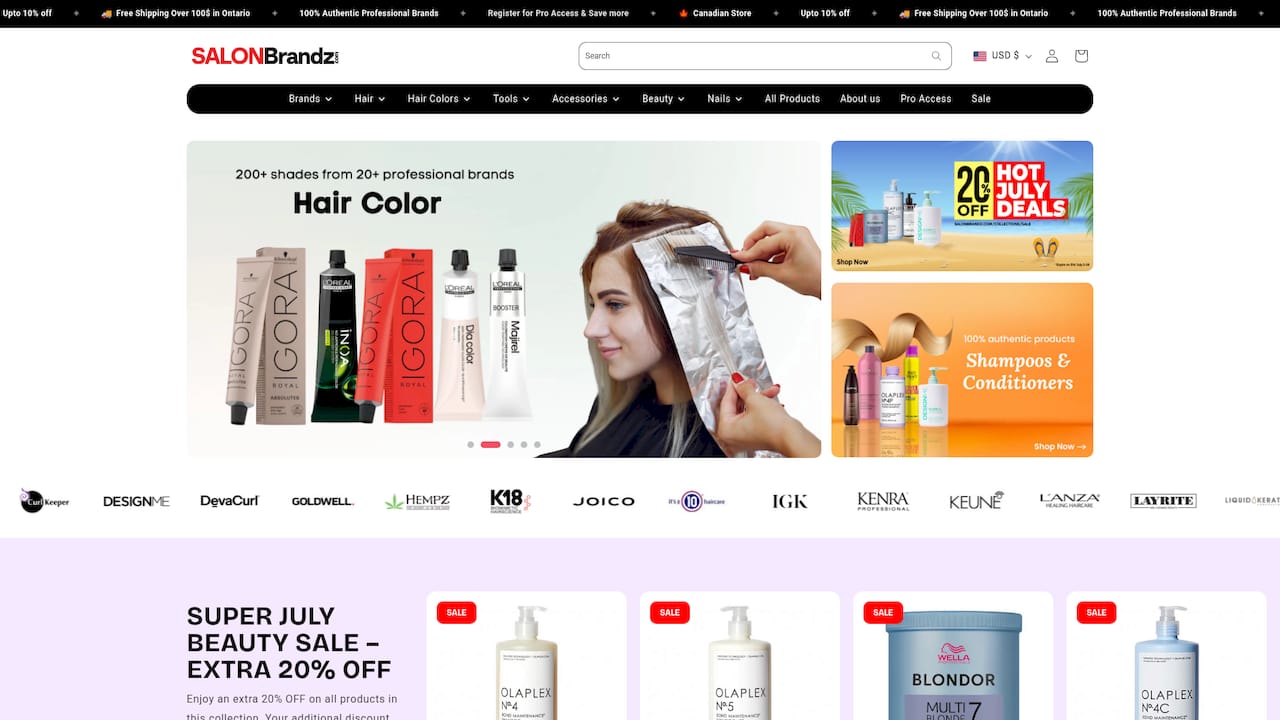
For stylists in the Greater Toronto Area, in-store pickup in Scarborough means you can get what you need the same day rather than waiting on shipping. For salons ordering in bulk, professional sizing (500 ml, 1000 ml) is available alongside single-use formats for at-home clients. Check the professional salon supplies page, confirm your colour line’s recommended developer form and ratio, and order with the tech sheet open.
Useful sources and technical references
- How to choose the right developer for hair colour — Glamot: volume-to-lift mapping and practical buying guidance.
- Liquid vs crème hair colour — Salonory education: tech-sheet reminder and form comparison for professional use.
- Cream developer for fine, colour-treated hair — Pure Spa Direct: guidance on gentle developer selection for fragile hair.
- Cream vs liquid developer: how texture changes your colour result — Blendsor: contact-time mechanics and gravity effects on vertical roots.
- Will a 30 vol developer lighten hair? — Ugly Duckling Color: safety note on developer-only application.
- Professional salon supplies Canada — Salonbrandz: pro developer formats, spec pages, and in-store pickup in Scarborough.


