


Hair dryer wattage explained: what Canadians need to know
Most home hair dryers draw between lower and higher wattages commonly found in consumer models sold in North America. For most Canadians, a dryer with a wattage in a moderate range hits the practical sweet spot: enough power to dry hair quickly without pushing against the limits of a standard 15 A household circuit.
The raw watt number matters less than you might think, though. Motor type, airflow, and heat control are what separate a dryer that works well from one that just runs hot. Here is what that means in practice:
- Performance: Higher wattage speeds drying mainly by generating more heat. A well-designed motor with strong airflow (measured in CFM) dries faster at lower wattage than a poorly designed high-watt model.
- Energy cost: A typical wattage dryer used 10 minutes a day adds up to meaningful electricity use over a year. The math is straightforward and covered below.
- Safety: Canadian homes run on 120 V. A standard 15 A circuit safely handles about 1,800 W of continuous load. A 1,875 W salon-grade dryer is right at that limit.
Salonbrandz, a Canadian supplier of professional salon tools with shipping across Canada and in-store pickup in Scarborough, stocks salon-grade dryers from brands like BaBylissPRO that are built around these exact specs.
Table of Contents
- What wattage range does your hair dryer actually need?
- How watts, amps, and volts work on a Canadian spec label
- Does higher wattage actually dry hair faster, or just damage it more?
- How much electricity does a hair dryer use, and what does it cost in Canada?
- Canadian electrical safety: what your circuits can actually handle
- How to choose the right dryer for your hair and your home
- Salonbrandz picks: salon-grade dryers available in Canada
- Worked examples: kWh, cost, and generator compatibility
- Travel and dual-voltage dryers: what to check before you fly
- Key takeaways
- The wattage number is not the whole story
- Salon-grade dryers, shipped across Canada
- Sources and further reading
What wattage range does your hair dryer actually need?
Wattage bands for hair dryers break down cleanly by use case. The numbers below reflect real-world product categories, not marketing tiers.
| Wattage band | Best for | Typical motor | Rough CFM | Energy per 10-min session |
|---|---|---|---|---|
| Under 1,000 W (travel/compact) | Short or fine hair, travel use | DC | 20 CFM | 0.125 kWh |
| 1,000–1,400 W (light use) | Fine, thin, or short hair | DC or AC | 30 CFM | 0.125–0.25 kWh |
| 1,400–1,875 W (everyday home) | Medium to thick hair, daily use | AC or BLDC | 40–50 CFM | 0.25–0.30 kWh |
| 1,875–2,400+ W (salon/high-power) | Thick, long, or coarse hair; back-to-back professional use | AC | 40–70+ CFM | 0.30–0.30 kWh |
A few things worth noting about each band:
- Travel dryers (under 1,000 W) are designed for convenience, not speed. Fine or short hair dries acceptably; thick or long hair takes noticeably longer.
- Light-use models (1,000–1,400 W) suit fine or colour-treated hair well. Lower heat output reduces thermal stress, which matters if your hair is already fragile.
- Everyday home dryers (1,400–1,875 W) cover the widest range of hair types. Good Housekeeping’s Beauty Lab recommends 1,500–2,000 W as the best all-round range, with 1,875 W appearing most frequently in its tested samples.
- Salon and high-power dryers (1,875–2,400+ W) are built for professional back-to-back use, with AC motors rated for long daily run times and higher CFM. At home, these push against standard circuit limits.
How watts, amps, and volts work on a Canadian spec label
Wattage is simply the rate at which a dryer draws electrical power. In a typical consumer dryer, about 80–90% of that wattage feeds the heating element. Only 10–20% actually drives the fan motor. That split explains why two dryers with identical wattage can feel completely different to use.
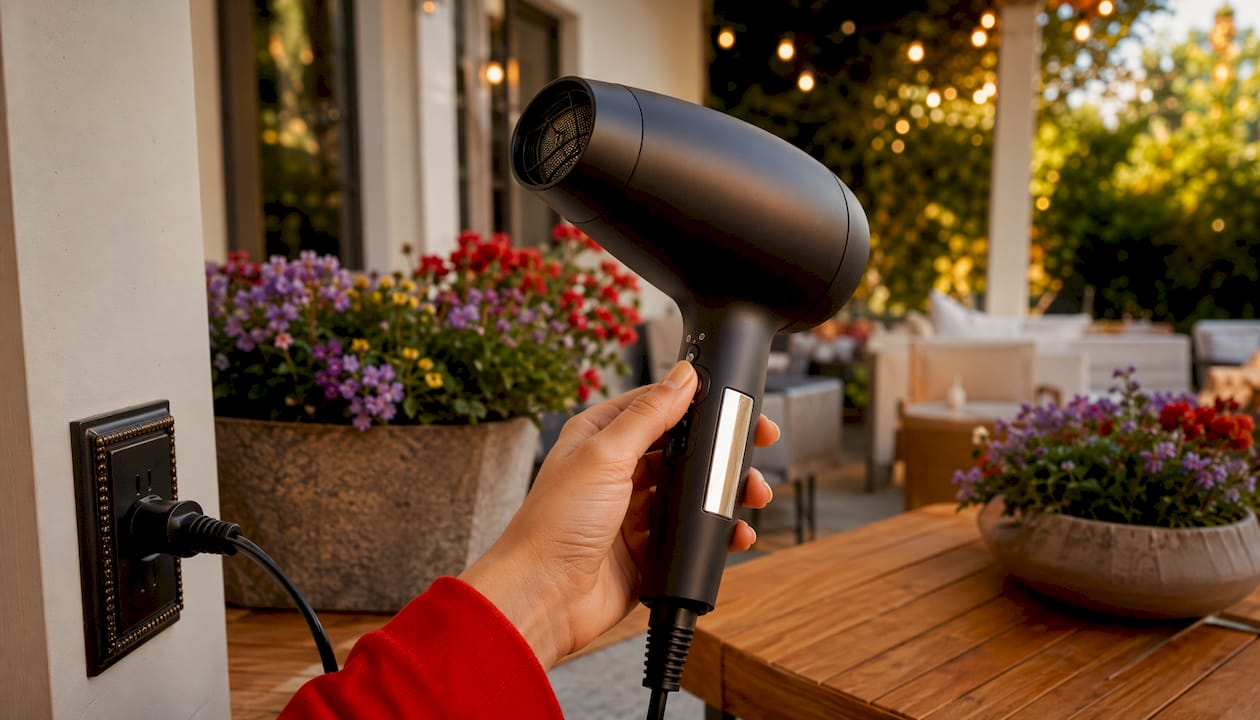
The formula: Amps = Watts ÷ Volts. Canada runs on 120 V (standard North American voltage).
A 1,875 W dryer draws: 1,875 ÷ 120 = 15.6 amps
That is already above the rated capacity of a standard 15 A circuit. In practice, a 15 A breaker is designed to trip at sustained loads above 80% of its rating, which works out to about 1,440 W for continuous use. The 1,875 W figure is why bathroom circuits in newer Canadian homes are often wired at 20 A.
Reading the label: Look for the spec plate on the dryer body or cord. It will list:
- W (watts) or A (amps) and V (volts) — if only amps and volts are listed, multiply them to get watts
- Hz — Canadian standard is 60 Hz; a dryer rated for 50 Hz only will run poorly or overheat here
- Dual voltage — look for “120–240 V” or “100–240 V” for travel use
- Continuous vs. intermittent — some labels note whether the wattage is a peak or sustained figure
Does higher wattage actually dry hair faster, or just damage it more?
This is where most buyers get misled. Higher wattage does not automatically mean faster drying or better results. Stylists consistently point to motor efficiency, airflow, and heat control as the real performance drivers, not the watt number on the box.
Here is why: a dryer that pushes more air through the barrel at the right temperature dries hair faster than one that simply runs hotter. High wattage without quality airflow design just increases heat exposure without improving drying speed, which raises the risk of thermal damage. BLDC (brushless DC) motors are the clearest example of this. They typically run at 1,200–1,600 W but deliver 40–70+ CFM, matching or beating traditional 2,000+ W AC dryers in actual drying time.
Wattage recommendations by hair type:
- Fine or damaged hair: 1,400–1,600 W with multiple heat settings and a cool-shot button. Advanced heat control at this range reduces thermal stress significantly.
- Medium or normal hair: 1,500–1,875 W with at least three heat settings.
- Thick, coarse, or long hair: 1,875–2,000+ W, or a lower-wattage BLDC model with high CFM.
Feature priority order for reducing heat damage:
- Motor type and airflow (BLDC or quality AC with high CFM)
- Infrared or ionic heat sensors that adjust temperature automatically
- Multiple heat and speed settings (at minimum: low, medium, high, and cool)
- Concentrator nozzle for directing airflow precisely
- Diffuser attachment for curly or wavy hair
Pro Tip: If you’re shopping for someone with colour-treated or chemically processed hair, look for a dryer with an ionic function. Ionic output reduces frizz and can lower the temperature needed to dry hair, cutting overall heat exposure. Salonbrandz carries BaBylissPRO models with this feature.
For more on protecting fragile hair during styling, Salonbrandz’s guide on treating dry and damaged hair covers heat-control strategies used in professional settings.
How much electricity does a hair dryer use, and what does it cost in Canada?
The formula is simple: (Watts ÷ 1,000) × Hours used = kWh consumed
A 1,800 W dryer used 10 minutes a day consumes roughly 109.5 kWh per year. Your actual cost depends on your province’s electricity rates. Rates vary considerably across Canada: Quebec’s hydro rates are among the lowest in the country, while Ontario and British Columbia sit in the mid-range, and some Atlantic provinces run higher.
Worked examples using a sample rate of $0.15/kWh (replace with your local rate from your utility bill):
- 1,500 W dryer, 5-minute session: (1,500 ÷ 1,000) × (5 ÷ 60) = 0.125 kWh. Cost: $0.019 per session. Monthly (30 sessions): $0.56.
- 1,500 W dryer, 10-minute session: 0.25 kWh per session. Cost: $0.038. Monthly: $1.13.
- 1,800 W dryer, 10-minute session: 0.30 kWh per session. Cost: $0.045. Monthly: $1.35.
- 2,200 W dryer, 10-minute session: 0.367 kWh per session. Cost: $0.055. Monthly: $1.65.
| Wattage | Session (10 min) | kWh/session | Monthly cost at $0.15/kWh | Annual kWh (10 min/day) |
|---|---|---|---|---|
| 1,500 W | 10 min | 0.25 kWh | $1.13 | — |
| 1,800 W | 10 min | 0.30 kWh | $1.35 | 109.5 kWh |
| 2,200 W | 10 min | 0.30 kWh | $1.65 | — |
The difference between a 1,500 W and a 2,200 W dryer amounts to about $6 per year at average Canadian rates. Energy cost alone is rarely the deciding factor. Where wattage choice matters more is on your home’s electrical circuit, covered next.
Canadian electrical safety: what your circuits can actually handle
A standard Canadian residential circuit runs at 120 V and is protected by either a 15 A or 20 A breaker. The math is straightforward:
- 15 A circuit: 120 V × 15 A = 1,800 W total capacity. The continuous-load guideline (80% of rated capacity) puts the safe sustained draw at about 1,440 W.
- 20 A circuit: 120 V × 20 A = 2,400 W total capacity. Continuous safe draw: about 1,920 W.
A 1,875 W dryer on a 15 A circuit is drawing above the continuous-load threshold. It may run fine for short sessions, but sustained use or sharing the circuit with another appliance risks tripping the breaker. This is why bathroom circuits in newer Canadian construction are typically 20 A.
Bathroom-specific safety:
- Use only outlets with GFCI (ground fault circuit interrupter) protection in bathrooms. These are the outlets with the test/reset buttons, required by the Canadian Electrical Code near water sources.
- Never use extension cords or adapters with a hair dryer. They can overheat at sustained high-wattage loads.
- Keep the dryer at least one metre from water sources when in use.
- Do not run a hair dryer and another high-draw appliance (curling iron, space heater) on the same circuit simultaneously.
When to consult an electrician: If you are bringing a salon-grade 2,000+ W dryer home for regular use, or setting up a home salon, having a dedicated 20 A circuit installed is worth the investment. A licensed electrician can confirm your panel capacity and run a dedicated line.
Pro Tip: Check the outlet in your bathroom. If it has test/reset buttons, it is GFCI-protected and meets the Canadian Electrical Code requirement for wet areas. If it does not, have an electrician upgrade it before using any high-wattage appliance there.
How to choose the right dryer for your hair and your home
Work through these questions before you buy. They cover the factors that actually affect performance and safety.
- What is your hair type? Fine or damaged hair needs lower wattage (1,400–1,600 W) with precise heat control. Thick or long hair benefits from 1,875 W or higher, or a BLDC model with strong airflow.
- How often do you dry your hair? Daily use justifies spending more on a quality motor. Occasional use makes a mid-range AC model perfectly sensible.
- What motor type do you want? BLDC motors are lighter, quieter, and more efficient. AC motors are proven workhorses for heavy use. DC motors are fine for travel or light use.
- Is CFM listed? If a manufacturer publishes CFM, use it. Higher CFM at a given wattage means better airflow efficiency. Anything above 50 CFM is strong for home use.
- How many heat and speed settings does it have? Three heat settings and two speed settings is a reasonable minimum. A cool-shot button is non-negotiable for setting a style.
- Does it have safety certifications? Look for CSA (Canadian Standards Association) or ETL certification on the label. These confirm the unit has been tested to Canadian safety standards.
- Is it dual-voltage? If you travel internationally, check for “100–240 V” on the label. A single-voltage dryer used abroad with only an adapter plug (not a converter) will burn out.
- What attachments are included? A concentrator nozzle is standard. A diffuser matters for curly or wavy hair. Some salon-grade models include a comb attachment for straightening.
Selection summary by hair type:
- Fine or colour-treated hair: 1,400–1,600 W, BLDC or quality AC, ionic function, multiple heat settings
- Normal or medium hair: 1,500–1,875 W, AC or BLDC, at least three heat settings
- Thick, coarse, or long hair: 1,875 W+, AC motor with high CFM, or BLDC with 60+ CFM
- Professional or salon use: 1,875–2,400 W, AC motor, rated for continuous use, CSA/ETL certified
Salonbrandz picks: salon-grade dryers available in Canada
Salonbrandz stocks professional salon tools with shipping across Canada and in-store pickup in Scarborough, near Toronto. The recommendations below map directly to the wattage and motor-type guidance in this article.
- Best for fine or colour-treated hair: A BaBylissPRO model with ionic and tourmaline technology in the 1,500–1,875 W range. The ionic output reduces frizz and allows lower heat settings, which cuts thermal stress on fragile hair. Salonbrandz carries the BaBylissPRO Nano Titanium line, which fits this profile.
- Best for thick or long hair: A salon-grade AC motor dryer at 1,875 W or higher with a concentrator nozzle and multiple heat settings. AC motors in this category are built for sustained airflow and long daily run times. Salonbrandz’s guide to the best dryers for salons walks through what separates these models from consumer-grade options.
- Best salon-grade option for home use: A BLDC-motor dryer in the 1,200–1,600 W range with 50+ CFM. These deliver professional drying speed on a standard 15 A circuit without the continuous-load risk of a 2,000+ W unit. Lighter weight is a practical bonus for daily home use.
Rohit, who handles product reviews and salon-grade tool curation for Salonbrandz, recommends prioritising motor type and CFM over raw wattage when comparing models. For personalised advice on which model fits your hair type and home setup, contact Salonbrandz directly or visit the Scarborough location.
Consulting a hair specialist before investing in a high-wattage professional dryer is also worth considering if you have concerns about heat damage or hair health.
Worked examples: kWh, cost, and generator compatibility
Per-session energy and cost
Example 1: 1,500 W dryer, 5-minute session (1,500 ÷ 1,000) × (5 ÷ 60) = 0.125 kWh. At $0.15/kWh: $0.019 per session.
Example 2: 1,875 W dryer, 10-minute session (1,875 ÷ 1,000) × (10 ÷ 60) = 0.3125 kWh. At $0.15/kWh: $0.047 per session.
Over a month of daily 10-minute sessions, the 1,875 W dryer costs about $1.41 at that rate. Swap in your actual provincial rate from your utility bill for a precise figure.
Generator and portable power station compatibility
This is one of the most common questions about hair dryer power consumption, and the answer is usually disappointing.
- Check continuous wattage, not peak wattage. A portable power station rated at 1,000 W continuous output cannot run a 1,500 W dryer, regardless of its peak or surge rating. The dryer’s draw exceeds the station’s sustained output.
- Surge wattage matters at start-up. Hair dryers with AC motors draw a brief surge above their rated wattage when they first switch on. A power station needs headroom above the dryer’s rated wattage to handle this.
- Inverter type matters. Sine-wave inverters (found in higher-end portable stations) run hair dryers more cleanly than modified sine-wave units, which can cause motor noise or overheating.
- Practical conclusion: Portable power stations with 1,000 W continuous output generally cannot safely run standard 1,500–1,875 W dryers. To run a typical home dryer off a generator or power station, you need a unit rated for at least 2,200–2,500 W continuous output, with a sine-wave inverter.
- Travel-size dryers are the exception. A compact 1,000 W travel dryer can run on a 1,200 W continuous-output station with margin to spare, making this a workable option for camping or off-grid use.
Travel and dual-voltage dryers: what to check before you fly
Most countries outside North America run on 220–240 V at 50 Hz. Plugging a single-voltage Canadian dryer (120 V, 60 Hz) into a European or Asian outlet without a voltage converter will destroy the dryer and may cause a fire.
Reading the label: A dual-voltage dryer will show “100–240 V, 50/60 Hz” on the spec plate. This means it auto-adjusts to the local voltage and frequency. You need only a plug adapter (not a converter) to use it abroad.
A dryer labelled “120 V only” needs a step-down voltage converter rated above the dryer’s wattage. These converters are heavy and bulky, which defeats the purpose of travelling light.
Practical travel tips:
- Most dual-voltage travel dryers run at 1,000–1,200 W. Drying time for thick or long hair will be noticeably longer than at home.
- BLDC travel dryers offer the best trade-off: lighter weight, quieter operation, and reasonable airflow despite lower wattage.
- Hotel rooms in Europe and Asia often have lower-rated bathroom circuits than Canadian homes. Using a high-wattage dryer can trip the room’s breaker.
- Fold-up or compact designs save luggage space, but check that the folding mechanism does not stress the cord at the joint. Cord damage at that point is a common failure mode.
For a broader look at heat versus non-heat interventions for hair health, including how travel and frequent styling affect hair condition over time, a clinical perspective can be useful.
Key takeaways
For most Canadians, a 1,500–1,875 W dryer with a quality motor and multiple heat settings covers every hair type without pushing against standard 15 A circuit limits.
| Point | Details |
|---|---|
| Sweet spot wattage | 1,500–1,875 W covers most hair types and stays within standard Canadian 15 A circuit limits. |
| Motor and CFM matter more | BLDC motors at 1,200–1,600 W can outperform 2,000+ W AC dryers when CFM is high. |
| Circuit safety limit | A 15 A circuit at 120 V handles about 1,800 W continuous; sustained loads above that risk tripping the breaker. |
| Energy cost perspective | A 1,800 W dryer used 10 minutes daily consumes roughly 109.5 kWh per year; cost difference between wattage tiers is small. |
| Salonbrandz recommendation | Salonbrandz stocks BaBylissPRO and other salon-grade dryers in Canada, matched to the wattage and motor-type guidance in this article. |
The wattage number is not the whole story
Most buyers fixate on wattage because it is the one number printed large on the box. After reviewing how dryers actually work, the more honest framing is this: wattage tells you how much electricity a dryer pulls, not how well it dries hair.
The 80–90% of wattage that feeds the heating element is doing one job: generating heat. The motor, which gets the remaining 10–20%, is doing the other job: moving air. A dryer that moves more air at a controlled temperature will outperform a hotter, less efficient model on almost every hair type. That is why a well-engineered BLDC dryer at 1,400 W can leave a cheap 2,000 W model looking slow and damaging by comparison.
For Canadian buyers, the circuit constraint is real and worth taking seriously. A 1,875 W dryer on a 15 A bathroom circuit is already at the edge of what that circuit is designed to handle continuously. Spending more on a 2,200 W model for home use does not buy you meaningfully faster drying. It buys you a higher chance of tripping a breaker and more heat exposure for your hair.
The practical advice is straightforward: match wattage to hair type, prioritise motor quality and CFM, and verify your bathroom circuit before buying anything above 1,875 W. The best dryer for most people is not the most powerful one on the shelf.
Salon-grade dryers, shipped across Canada
Professional hair dryers from brands like BaBylissPRO are built around the exact specs this article covers: AC or BLDC motors with genuine CFM ratings, multiple heat settings, and CSA-compliant safety certifications. At Salonbrandz, these are not consumer-grade rebrands. They are the same tools used in professional salons, available with shipping across Canada and in-store pickup in Scarborough near Toronto.

Whether you are upgrading from a worn-out consumer dryer or equipping a home salon, Salonbrandz carries options matched to every hair type and circuit situation covered in this article. Visit Salonbrandz to browse the full range of professional salon supplies, or stop in at the Scarborough location for hands-on guidance.
Sources and further reading
The sources below back the figures and recommendations in this article. Canadian readers can use the electricity-rate links to find their own provincial rates for the energy-cost calculations.
| Source | Why it is relevant for Canadian readers |
|---|---|
| EnergySage: How Many Watts Does a Hair Dryer Use? | Primary source for the kWh formula and annual energy-use figures; use with your provincial rate from your utility bill. |
| Hairstorm: Wattage, Airflow, Motor Technology | Detailed breakdown of wattage allocation between heating element and motor; supports BLDC vs AC comparisons. |
| Hairstorm: | Circuit-limit guidance and continuous-load math for Canadian 15 A circuits. |
| Good Housekeeping Beauty Lab | Independent lab testing supporting the 1,500–2,000 W recommended range. |
| Allure: Expert tips on buying a hair dryer | Stylist perspective on motor efficiency and airflow as primary performance drivers. |
| Salonbrandz: Best dryers for salons | Salonbrandz’s own guide to salon-grade dryer selection, motor types, and professional use cases. |
| Salonbrandz: BaBylissPRO Nano Titanium | Product detail for the BaBylissPRO model recommended for fine and colour-treated hair. |


