


Your complete heat protectant spray guide for Canadian hair
Use a heat protectant spray every single time you style with heat. That one habit does more for your hair’s long-term health than switching shampoos, buying a better flat iron, or any deep-conditioning treatment you apply afterward. A protectant creates a thin, heat-resistant film over the hair shaft that slows heat transfer, seals the cuticle, and reduces moisture loss during styling. Professional salon guidance confirms that protectants reduce, rather than eliminate, heat damage — but that reduction compounds over months of consistent use.
Three things to do before your next styling session:
- Spray on damp hair before blow-drying, or on fully dry hair before flat-ironing or curling.
- Comb through from mid-lengths to ends so every strand gets coverage.
- Set your tool temperature to match your hair type: 250°F–300°F for fine or damaged hair, up to 375°F for thick or coarse hair.
For blow-drying, a lightweight mist works best. For flat irons and wands, a dry-mist or heat-activated spray gives you more control without adding moisture that can cause sizzling.
Key takeaways
A heat protectant spray reduces cumulative thermal damage when applied correctly every time you style, but technique and temperature discipline matter as much as the product you choose.
| Point | Details |
|---|---|
| Use it every time | Apply before every heat-styling session, not just occasionally, to reduce cumulative damage. |
| Match formula to hair type | Fine hair needs a lightweight mist; thick or coarse hair benefits from richer sprays with oils or humectants. |
| Temperature matters too | Keep tools at or below 400°F and choose a spray rated at or above your tool’s working temperature. |
| Apply correctly | Mist from 6–8 inches, comb through mid-lengths to ends, and wait briefly before applying heat. |
| Salonbrandz for Canada | The Curl Keeper Thermal Defence Heat Protectant and professional-size formats are available with Canada-wide shipping and Scarborough pickup. |
Table of Contents
- Why does heat damage your hair, and what does a protectant actually do?
- How do you choose the right heat-protectant spray for your hair?
- How to apply heat protectant correctly, step by step
- Salon-grade heat-protectant picks available in Canada
- How we test and review heat-protectant sprays
- Common myths about heat protectants worth clearing up
- The part of heat-protectant advice most guides get wrong
- Salon-grade heat protectants, shipped across Canada
- Sources
- FAQ
Why does heat damage your hair, and what does a protectant actually do?
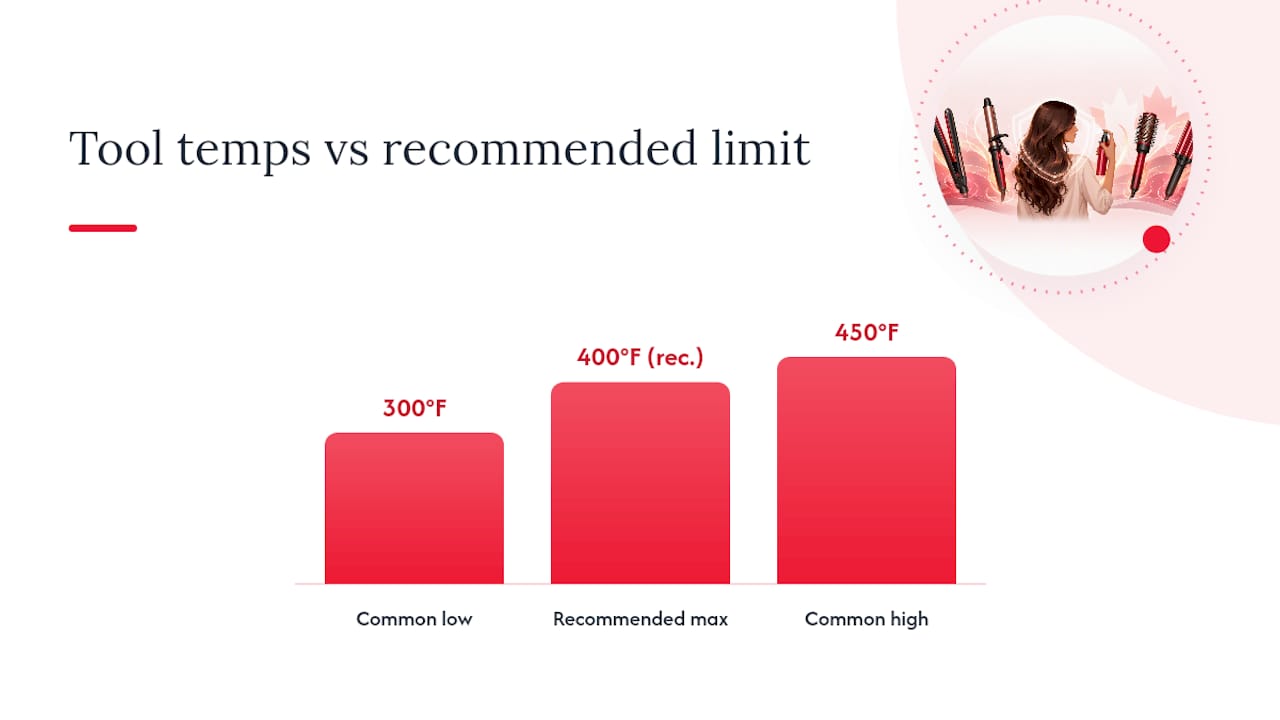
Heat damages hair by degrading keratin, the protein that gives each strand its structure. Styling tools commonly reach temperatures between 300°F and 450°F/230°C, and at those levels the cuticle lifts, moisture escapes, and the cortex weakens. The result is breakage, frizz, and dullness that gets worse with every session because the damage is cumulative.
A heat protectant works by forming a thin polymer or silicone film over the hair shaft. That film slows heat transfer to the cortex, helps the cuticle lie flat, and reduces moisture loss during styling. The practical benefits include:
- Reduced breakage from repeated thermal stress
- Frizz control as the cuticle stays smoother
- Colour protection since sealed cuticles hold pigment longer
- Improved smoothness and shine from conditioning agents in the formula
The caveat worth repeating: no spray makes your hair immune to heat. Insider Beauty’s best-practice guidance notes that keeping your styling temperature under 400°F is as important as the product itself. A protectant buys you a meaningful margin of safety; it doesn’t replace sensible temperature habits.
How do you choose the right heat-protectant spray for your hair?
The short rule: match formula weight to your hair texture, and match the product’s claimed heat rating to your tool’s actual temperature.
Ingredients to look for (and when they help):
- Silicones (dimethicone, cyclomethicone): excellent heat barrier and shine; can build up on fine hair with daily use
- Film-forming polymers (PVP, acrylates): lightweight protection, good for fine or colour-treated hair
- Proteins (hydrolysed keratin, rice protein): strengthen the shaft from within; useful for damaged or chemically treated hair. Formulas like the QAI Tiger Moisture Mist use rice protein alongside conditioning agents for thermal defence
- Humectants (glycerin, panthenol): retain moisture during heat exposure; great for dry or coarse hair
- Oils (argan, coconut): add weight and shine; better for thick hair, can flatten fine hair
- UV absorbers: reduce colour fade from heat and sun exposure, worth prioritising for colour-treated hair
Practical checklist before you buy:
- Fine hair: choose a lightweight, silicone-free mist or polymer-based spray
- Normal to medium hair: most spray formulas work; look for a claimed rating of at least 350°F
- Thick or coarse hair: a richer spray or one with oils and humectants handles higher temperatures better
- Colour-treated hair: look for UV absorbers and colour-safe labelling
Pro Tip: Check the product label for its maximum claimed temperature. If your flat iron runs at 430°F and the spray claims protection only to 350°F, you are outside the tested range. Choose a product rated at or above your tool’s working temperature.
For a broader look at how sprays compare to serums, creams, and oils, the guide to hair care product types on Salonbrandz breaks down which format suits which hair type.
How to apply heat protectant correctly, step by step
Application technique affects real-world performance more than most people realise. Evo’s stylist guidance is direct on this: uneven coverage leaves sections of hair unprotected, regardless of how good the formula is.
For blow-drying (damp hair):
- Towel-dry hair until damp, not dripping.
- Divide hair into two or four sections.
- Hold the spray 6–8 inches from your hair and mist each section lightly.
- Comb through from mid-lengths to ends to distribute evenly.
- Wait 30–60 seconds for the product to settle before turning on the dryer.
For flat irons or curling wands (dry hair):
- Start with fully dry hair.
- Take a 1–2 inch section, mist lightly from 6–8 inches away.
- Comb through, then pass the iron or wand through once.
- Move to the next section; reapply if you plan to go over the same section twice.
L’Oréal Paris’s application guidance confirms the 6–8 inch distance as the standard for even coverage without creating wet patches that sizzle under a flat iron.
Common mistakes to avoid:
- Spraying directly onto the roots (adds weight and buildup without protecting the ends that need it most)
- Oversaturating one section while missing others
- Skipping the comb-through step
- Applying to soaking-wet hair before blow-drying (dilutes the formula)
- Using a spray rated for blow-drying on a 450°F flat iron
For extensions, apply to the hair itself, not the bonds, and use a lightweight formula to avoid buildup at the attachment points.
Salon-grade heat-protectant picks available in Canada
The Curl Keeper Thermal Defence Heat Protectant is the standout pick for Canadians buying through Salonbrandz. It is a professional-size thermal-protection product designed for styling professionals and available for shipping across Canada or in-store pickup in Scarborough. Curl Keeper’s formula targets defined, frizz-prone hair types and works on both damp and dry hair.
Beyond that specific product, Salonbrandz stocks salon-grade heat-protection products across several formula categories:
- Lightweight mists: best for fine or colour-treated hair; polymer-based, low residue
- Conditioning sprays with proteins: suited to damaged or chemically treated hair
- Richer thermal sprays with oils: for thick or coarse hair that needs higher-temperature coverage up to 450°F
| Feature | Lightweight mist | Protein-enriched spray | Oil-based thermal spray |
|---|---|---|---|
| Best for | Fine, colour-treated | Damaged, chemically treated | Thick, coarse |
| Max heat rating | Up to 450°F | Up to 450°F | Up to 450°F |
| Texture/weight | Very light | Medium | Medium to rich |
| Silicone-free option | Often available | Sometimes | Rarely |
Salonbrandz carries professional-size formats, which are more cost-effective for stylists and regular home users. Pro access registration on the site unlocks additional pricing, and in-store pickup in Scarborough is available for same-day collection.
How we test and review heat-protectant sprays
Product picks in this guide are based on a structured review process that looks beyond marketing claims.
- Coverage test: spray is applied to sectioned hair and checked for even distribution and missed patches
- Residue check: hair is assessed after one session and after five consecutive sessions for buildup, greasiness, and weight
- Temperature performance: products are tested at the temperatures stated on their labels, using calibrated styling tools
- Hair-texture panel: testing covers fine, medium, thick, and colour-treated hair to catch formula-specific issues
- Scent and weight notes: recorded because both affect real-world compliance — a heavy or strongly scented spray gets skipped
Hairstylist review rounds add a professional layer: stylists assess how the product behaves during sectioning, whether it sizzles or smokes at the claimed maximum temperature, and how hair feels after repeat styling. Products that perform well in single-use tests but show degradation after five sessions are flagged.
Common myths about heat protectants worth clearing up
“Any oil works as a DIY heat protectant.” Coconut oil and argan oil have some thermal properties, but they are not formulated to withstand 400°F+ styling temperatures. A DIY heat protectant made from kitchen oils gives you partial, inconsistent coverage at best. Salon-grade sprays use film-forming polymers and silicones engineered specifically for heat resistance.
“More product means more protection.” Oversaturating your hair does not increase the protective barrier. It adds weight, can cause sizzling under a flat iron, and leads to buildup. A light, even mist is more effective than a heavy application.
“You only need it for flat irons.” Blow-dryers regularly reach 200°F–300°F at the nozzle, which is well within the range where repeated exposure causes cumulative damage. A protectant is worth using for every heat tool, including diffusers on high heat.
“Heat protectant replaces conditioner.” These are different products doing different jobs. Conditioner restores moisture and smoothness after washing; a protectant creates a temporary barrier during heat styling. You need both.
“Once you apply it, you’re covered for the whole session.” If you restyle a section or go over it a second time with a flat iron, reapply. The film breaks down with heat exposure, so a second pass on unprotected hair is still a second pass on unprotected hair.
The part of heat-protectant advice most guides get wrong
Most heat-protectant content focuses almost entirely on product choice. Pick the right spray, the articles say, and you are set. The reality is that technique matters at least as much as formula. A mediocre spray applied correctly, section by section with a comb-through and a brief wait, will outperform a premium product misted unevenly onto soaking-wet hair.
The second thing most guides underplay is temperature discipline. Protectants are not a licence to run your flat iron at maximum heat. The Allure editorial testing that informs much of the industry’s product coverage is clear that damage is cumulative. Dropping your tool from 450°F to 380°F and using a protectant consistently is a better long-term strategy than using the best spray on the market at the highest setting every day.
For Canadians specifically, the practical gap is access to salon-grade formats. Most drugstore options come in small bottles with limited ingredient transparency. Buying through a professional supplier like Salonbrandz gives you access to the same product sizes and formulas that stylists use in-chair, which is a real difference when you are styling frequently. Pair that with the common hair care mistakes guide to close the other gaps in your routine.
Salon-grade heat protectants, shipped across Canada
Salonbrandz carries the Curl Keeper Thermal Defence Heat Protectant and a full range of professional heat-protection products, available for shipping anywhere in Canada or in-store pickup in Scarborough near Toronto. Professional-size formats mean better value per application for anyone styling regularly.
Pro access registration on the Salonbrandz site unlocks trade pricing, and the product range covers every formula type discussed in this guide: lightweight mists, protein-enriched sprays, and richer thermal formulas for thick or coarse hair. Browse the full selection and place your order at Salonbrandz.
Sources
- Best heat protectant sprays | Allure
- Heat Protectant Spray Best Practices | Insider Beauty
- How To Use Heat Protectant The Right Way | L’Oréal Paris
- How To Use Heat Protection Spray The Right Way | Evo US
- Do You Really Need a Heat Protectant Spray? – Paul Mitchell UK
FAQ
Does heat protectant spray actually work?
Yes. It forms a thin film that slows heat transfer to the hair shaft and reduces cumulative damage. It reduces, rather than eliminates, heat damage, so consistent use alongside sensible tool temperatures gives the best results.
Should you apply heat protectant to damp or dry hair?
Apply to damp hair before blow-drying and to fully dry hair before using a flat iron or curling wand. Applying a spray to soaking-wet hair before ironing can cause sizzling and dilutes the protective film.
How far away should you hold the spray?
Hold the spray 6–8 inches from your hair for even coverage without creating wet patches. Mist lightly, then comb through from mid-lengths to ends before applying heat.
What temperature should you set your styling tools?
Fine or damaged hair: 250°F–300°F. Colour-treated or average hair: 300°F–350°F. Thick or coarse hair: 350°F–375°F. Avoid repeated daily use above 400°F regardless of hair type.
Where can you buy salon-grade heat protectant in Canada?
Salonbrandz carries the Curl Keeper Thermal Defence Heat Protectant and other professional heat-protection products, available with shipping across Canada and in-store pickup in Scarborough near Toronto.


