

Salon chair cost Canada: what salon owners should budget
Most salon chairs sold in Canada fall into three clear bands: entry-level hydraulic styling chairs run from low to mid hundreds of CAD, mid-range professional chairs run from mid to around one thousand CAD, and premium or specialty chairs (reclining, barber, high-end shampoo units) run at higher prices starting around one thousand CAD. For most Canadian salon owners furnishing a working commercial station, the smart move is to buy mid-range: skip the cheapest hydraulic units, which tend to fail fast under daily use, and skip paying premium prices unless the chair does something your entry chair genuinely can’t.
Here’s the one-line verdict for anyone stocking a shop with one to ten chairs: buy mid-range hydraulic chairs from a Canadian supplier with parts support, and treat the hydraulic pump as the deciding factor, not the upholstery.
A few things worth knowing before you order anything:
- Sticker price examples across the market range from roughly $115 to $1,060+ depending on the chair type and materials.
- The hydraulic lift is the single component most likely to fail first, and it’s the one part worth spending extra on.
- Salon Brandz ships across Canada and offers in-store pickup in Scarborough, which cuts out the freight and brokerage guesswork that comes with ordering heavy furniture from outside the country.
Pro Tip: Before comparing prices between two chairs, ask both sellers to name the hydraulic pump brand. A no-name pump is often where the “savings” evaporate within eighteen months.
Key Takeaways
Mid-range hydraulic chairs, priced roughly $400 to $1,000 CAD, deliver the best balance of durability and cost for most Canadian commercial salons.
| Point | Details |
|---|---|
| Know your price band | Entry chairs run $150–$400, mid-range $400–$1,000, premium $1,000–$3,000+. |
| Hydraulic lift is the deciding factor | Test the pump in person and confirm parts availability before comparing prices. |
| Calculate landed cost, not sticker price | Add shipping, GST/HST, installation, and first-year maintenance before budgeting. |
| Buy Canadian to cut freight risk | Domestic stock and pickup avoid brokerage delays common with cross-border orders. |
| Stage purchases by traffic | Outfit your busiest stations first with mid-range chairs, then upgrade over time. |
| Salon Brandz offers a domestic path | Ships across Canada with in-store pickup in Scarborough, reducing freight and parts-sourcing risk. |
Table of Contents
- Salon chair cost Canada: price ranges by chair type
- What actually drives salon chair cost
- Total cost of ownership: what the sticker price doesn’t include
- Where to buy salon chairs in Canada
- Canadian supplier spotlight: buying from Salon Brandz
- Buying checklist and red flags to avoid
- Recommended budgets by salon type
- What Canadian salon owners get wrong about chair pricing
- Get your chairs from a supplier that actually stocks Canada
- Sources
- FAQ
Salon chair cost Canada: price ranges by chair type
Chair type changes the math more than most buyers expect. A shampoo chair without a lift mechanism costs less than a full hydraulic styling chair with the same upholstery quality, and a barber chair with a heavy-duty base built for all-day recline costs more than either.
| Chair type | Typical price range (CAD) | Best suited for |
|---|---|---|
| Styling chair (hydraulic) | Entry to premium range, from a few hundred to over one thousand CAD | General stylist stations |
| Barber chair | Mid to high price levels, from several hundred to multiple thousands CAD | Barbershops, heavy daily recline use |
| Shampoo chair (basic, no recline) | Starting from low to mid hundreds CAD | Wash stations, shampoo assistants |
| Reclining shampoo chair | Mid-range to high, with prices increasing for premium models | Spa-style or premium wash rooms |
| Specialty/vintage barber chair | Higher price bracket reflecting boutique and statement pieces | Boutique barbershops, statement pieces |
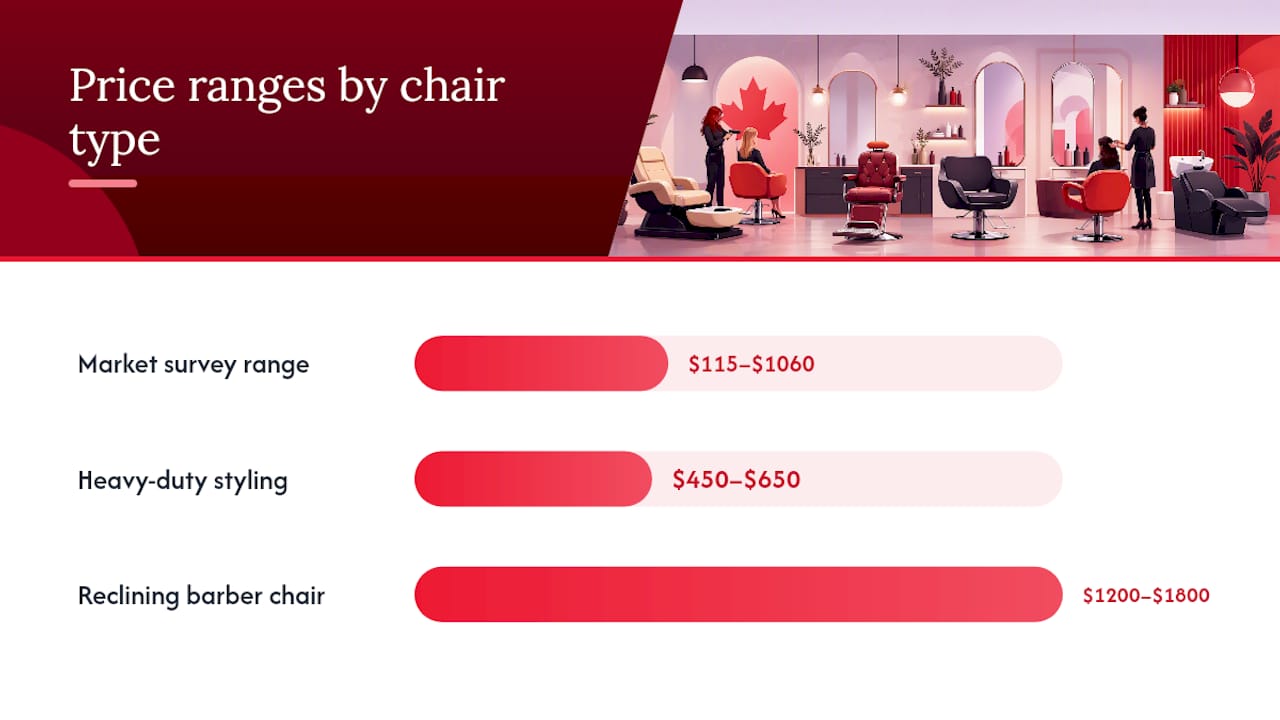
A wide market survey of styling and barber chairs shows prices spanning roughly $115 to $1,060 across a mix of consumer and professional-grade models, and that spread is exactly why “how much does a salon chair cost” doesn’t have one answer. A $150 chair and a $900 chair can look nearly identical in a product photo. The difference shows up six months later, in how the pump handles forty adjustments a day instead of four.
Commercial use is what pushes buyers toward the mid and high bands. A chair in a home studio doing a dozen cuts a week can survive on a lighter-duty hydraulic system. A chair in a six-station salon doing sixty appointments a week cannot, and the failure usually happens at the worst possible time, mid-appointment, with a client in the chair.
Two representative examples to make this concrete:
- Heavy-duty hydraulic styling chair, mid band: $450–$650, steel base, mid-grade vinyl upholstery, standard footrest.
- Reclining barber chair, high band: $1,200–$1,800, all-steel pump housing, extended recline, reinforced armrests for heavier daily use.
What actually drives salon chair cost
Two chairs that look nearly the same in a catalogue photo can be $400 apart. The gap almost always comes down to a handful of components, not brand markup.
- Hydraulic lift quality — the single biggest factor in both price and long-term reliability.
- Frame and base material — cast steel bases cost more than stamped metal but handle daily weight cycling far better.
- Upholstery type — commercial-grade vinyl resists cracking and cleaning chemicals better than budget vinyl, and it costs more up front.
- Weight capacity — chairs rated above 300 lbs use heavier internal components across the board.
- Recline mechanism — barber chairs and reclining shampoo units add mechanical complexity that raises both price and repair cost.
- Warranty and parts access — a 1 year warranty versus a 3 to 5 year warranty on the pump tells you a lot about how the manufacturer expects the chair to perform.
- Integrated features — built-in footrests, adjustable headrests, and shampoo-compatible basins add cost but reduce the need for separate accessories.
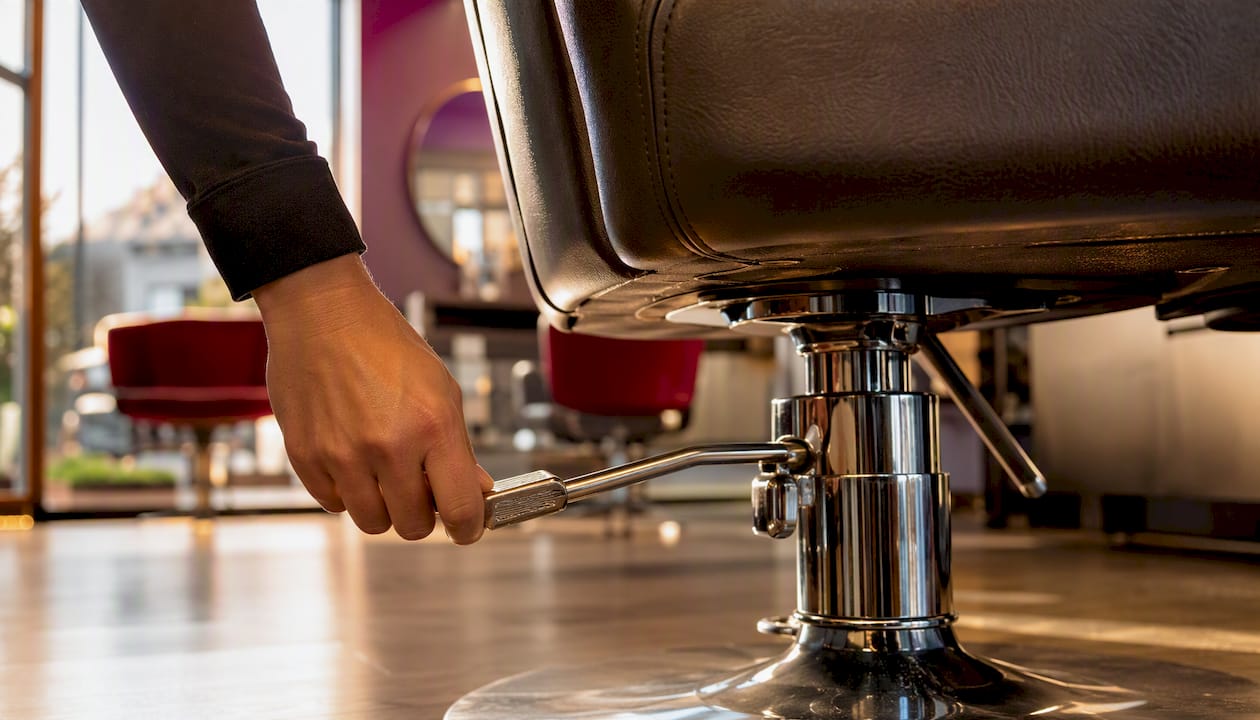
The hydraulic lift deserves its own callout because it’s the part that fails first, and it’s expensive to fix on-site. A worn pump doesn’t just annoy a stylist. It takes a station out of rotation, and a chair sitting empty during a Saturday rush is lost revenue, not just an inconvenience. Component breakdowns from industry cost guides show hydraulic lift systems as one of the largest single line items in a chair’s build cost, right alongside the base and upholstery.
Pro Tip: When you’re testing a chair in a showroom, pump the lift lever ten to fifteen times in a row. A quality hydraulic system stays smooth and consistent. If it starts sticking or feels gritty by pump six, that’s the pump telling you what year three will look like. Also ask upfront whether replacement pumps are stocked in Canada, since sourcing one from overseas can take weeks.
Total cost of ownership: what the sticker price doesn’t include
The number on the product page is rarely the number you actually pay. A realistic landed cost calculation looks something like this:
- Sticker price — say $600 for a mid-range hydraulic styling chair.
- Shipping and duties — freight for heavy furniture crossing into Canada can add anywhere from a modest percentage to a significant chunk of the sticker price, and brokerage fees and duty can catch buyers off guard if the seller doesn’t disclose them upfront.
- Setup and installation — assembly or minor electrical work for powered recline chairs adds a per-unit labour cost.
- First-year maintenance — budget for at least one pump adjustment or upholstery touch-up per chair in year one under commercial use.
Add those four together and a $600 chair can land closer to $750 to $900 once it’s actually bolted to the floor and ready for a client.
Ongoing costs to plan for beyond that first year:
- Replacement hydraulic pumps
- Upholstery repair or reupholstering
- Pump servicing and lubrication
- Disposal or trade-in of old chairs
- Extended warranty coverage on high-use stations
Downtime is the cost most owners forget to budget for. A chair out of service for a week while you wait on a part isn’t just a repair bill, it’s a station generating zero revenue during your busiest days.
Where to buy salon chairs in Canada
Canadian salon owners generally have four realistic paths to a purchase, and each one carries different risk around timing and hidden fees.
- Canadian wholesalers and distributors with in-country stock, which avoids cross-border shipping entirely.
- Showroom or warehouse pickup, useful for testing the hydraulic action in person before buying.
- Canadian e-commerce retailers that ship domestically and quote prices in Canadian dollars.
- Cross-border purchases from U.S. sellers, which can look cheaper on the surface but carry freight, brokerage, and duty risk.
Always confirm whether a listed price includes GST/HST, and whether the seller or a third-party broker handles duties on anything shipped from outside Canada. Freight shipments crossing into Canada get flagged for brokerage far more often than small parcels, and heavy furniture almost always ships freight, not parcel, which changes both the cost and the paperwork.
Typical lead times: in-stock domestic orders usually arrive in one to two weeks. Imported bulk orders, especially multi-chair salon buildouts, can run four to eight weeks once you account for customs clearance and freight scheduling.

Pro Tip: If you’re outfitting more than three stations at once, ask your supplier for a written landed-cost quote that includes tax and any brokerage fee before you commit. A verbal “should be around” estimate is where most surprise invoices come from.
Canadian supplier spotlight: buying from Salon Brandz
Salon Brandz operates as a Canadian supplier of professional salon products and equipment, with delivery across the country and in-store pickup in Scarborough, near Toronto. For a salon owner weighing a cross-border order against a domestic one, that pickup option alone removes the freight and brokerage variables that complicate ordering heavy chairs from outside Canada.
Buying a hydraulic chair from a supplier that stocks parts domestically means a worn pump is a phone call and a short wait, not a six-week overseas reorder.
What that looks like in practice for total cost of ownership:
- Local pickup avoids freight charges and duty uncertainty entirely.
- A Canadian-based supplier is easier to reach for warranty claims and replacement parts than an overseas seller.
- Product guides on hydraulic lift quality and barber chair selection give buyers a way to compare specs before ordering, not just after something breaks.
Pro Tip: If you’re within driving distance of Scarborough, book a pickup slot instead of shipping. You get to test the pump in person, which is the single best way to catch a weak hydraulic system before it’s in your salon.
Buying checklist and red flags to avoid
Run through this before you sign off on any order, especially if you’re buying more than one chair at a time.
- What’s the warranty length, and does it cover the hydraulic pump specifically?
- Are replacement pumps and parts stocked in Canada, or ordered from overseas?
- What’s the realistic lead time from order to delivery?
- Does the quoted price include GST/HST?
- Who handles freight and brokerage on cross-border orders, you or the seller?
- What’s the returns policy if a chair arrives damaged?
Watch for these red flags:
- No clear answer on where replacement parts come from.
- Vague or unwritten warranty terms.
- A price that seems too low with zero mention of service or support.
- An unbranded or unnamed hydraulic pump.
- No Canadian address or phone number listed anywhere on the site.
If you’re buying four or more chairs at once, ask about trade or bulk pricing. Most suppliers have room to move on multi-unit orders even when single-chair pricing looks fixed.
Recommended budgets by salon type
Your salon model should set your per-chair budget, not the other way around.
- Starter or solo stylist: budget $300–$500 per chair. One or two hydraulic styling chairs, mid-tier upholstery, standard warranty. No need to overspend on recline features you won’t use solo.
- Full-service small salon (2–6 chairs): budget $500–$900 per chair. This is where daily-use durability matters most, since these chairs see the highest cycle count in the whole shop.
- Premium boutique: budget $1,000–$2,500+ per chair, especially for reclining shampoo units or statement barber chairs that double as part of the client experience.
Quick priorities by scenario:
- Starter shops should prioritise warranty length over extra features.
- Full-service salons should prioritise hydraulic durability and confirmed local parts access above upholstery style.
- Premium boutiques should prioritise comfort features and finish quality once durability basics are covered.
If cashflow is tight, stage the purchase: buy your highest-traffic stations first with mid-range hydraulic chairs, then upgrade lower-traffic stations or add premium pieces over the following one to two quarters. A salon equipment checklist can help you sequence chair purchases against everything else a new shop needs.
What Canadian salon owners get wrong about chair pricing
Most owners shop for the lowest sticker price and treat the hydraulic pump as an afterthought. That’s backwards. The pump is the part that determines whether your $350 “deal” is still working in year two, and it’s the part almost nobody asks about before buying.
The other mistake is ignoring landed cost until the invoice arrives. A chair that looks $150 cheaper from a U.S. listing can end up costing more once freight, brokerage, and duty land on your desk weeks later. Buying domestically from a Canadian supplier isn’t just patriotic convenience, it’s a real hedge against that kind of surprise.
If there’s one thing worth prioritizing above all else, it’s parts access. A warranty that promises a replacement part from overseas in “four to six weeks” is a warranty that will cost you a chair’s worth of revenue the first time it’s tested. Buy from a supplier who stocks parts here, ask hard questions about the pump before you buy, and stage your purchases so cashflow never forces a compromise on the one component that actually matters.
Get your chairs from a supplier that actually stocks Canada
Salon Brandz is the practical alternative to guessing your way through cross-border freight quotes and brokerage fees: a Canadian supplier with national shipping and in-store pickup in Scarborough, so the chair you order is the chair you can actually service later.
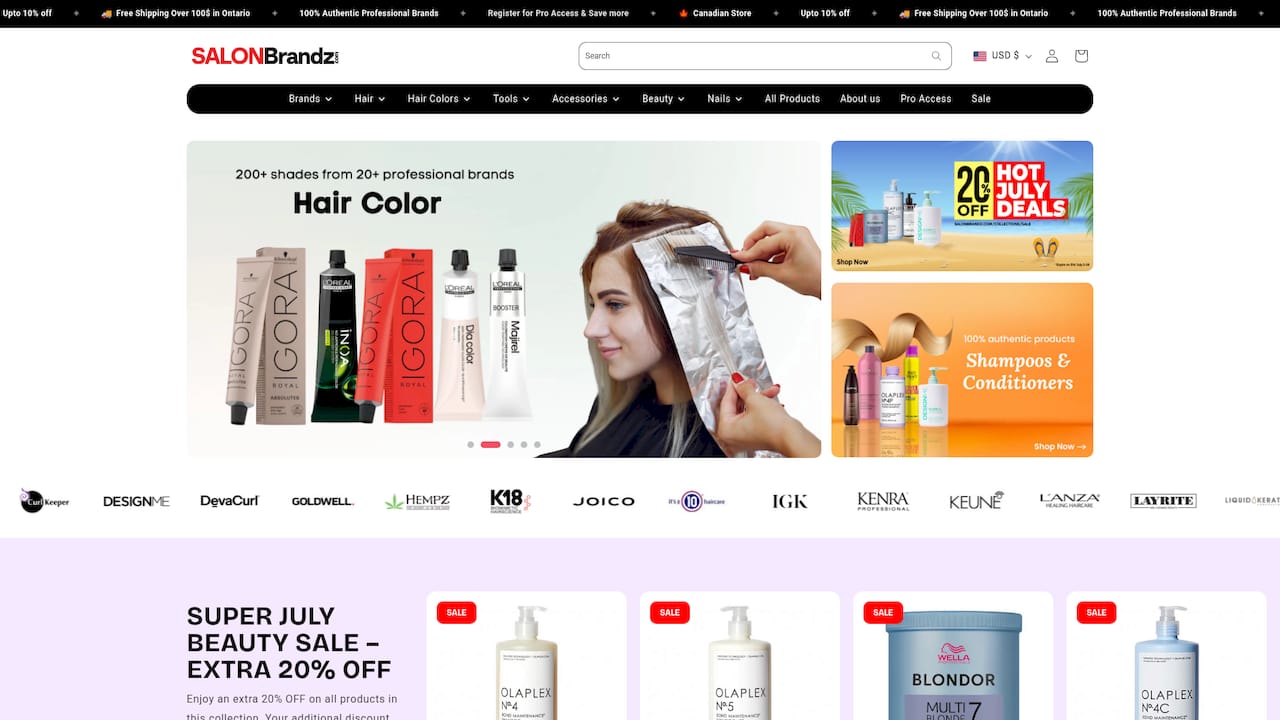
That matters most for the hydraulic pump question this whole guide keeps coming back to. When parts and support sit inside Canada instead of overseas, a warranty claim is a phone call, not a six-week wait. Salon Brandz carries professional-grade salon equipment alongside the products and tools most shops already order, which means you can outfit a station and restock your colour and styling supplies in a single order instead of juggling multiple vendors.
If you’re planning a purchase for one chair or a full six-station buildout, check current stock and shipping timelines directly on Salon Brandz before you commit to a cross-border order. Confirming lead times now saves you from a delivery surprise the week before a big booking push.
Sources
- 15 Best Salon Chairs and How to Pick the Right One — Noona HQ
- Shipping to Canada from the US
- Barber Chair Cost Guide for U.S. Buyers 2026 – Adnan Painting and Remodeling - Digital Database
FAQ
How much does a salon chair typically cost in Canada?
Entry-level hydraulic styling chairs run $150 to $400 CAD, mid-range professional chairs run $400 to $1,000, and premium or specialty chairs run $1,000 to $3,000 or more depending on features and recline mechanisms.
How much does a barber chair cost?
Barber chairs generally start around several hundred dollars for basic hydraulic models and can reach higher prices for heavy-duty or specialty barber chairs built for all-day recline use.
How much does it cost to open a salon in Canada?
Startup costs vary widely by size and location, but chairs are one of the largest single equipment line items. Budgeting $400 to $900 per chair for a small salon gives a realistic starting point for that portion of the buildout.
How much do salon owners make in Canada?
Salon owner income varies significantly by location, chair count, and service mix, and there’s no single reliable Canadian figure to cite. What’s consistent is that equipment reliability, especially chairs that avoid mid-shift breakdowns, directly protects daily revenue.
Where should Canadian salon owners buy chairs to avoid shipping surprises?
Buying from a Canadian supplier with domestic stock, such as Salon Brandz, avoids the freight, duty, and brokerage complications that come with ordering heavy furniture from outside the country.


