


Salon disinfection rules in Canada: your compliance guide
To be inspection-ready in Canada, every salon and spa must follow this sequence without exception: clean first to remove visible debris, classify each instrument, apply a Health Canada-authorised disinfectant at the correct dilution for the full label contact time, and record every step in a dated log. That is the core of Canadian salon disinfection requirements, and everything else in this guide builds on it.
Act on these today:
- Confirm every disinfectant on your shelf carries a Drug Identification Number (DIN) or Medical Device Licence (MDL) — U.S. EPA or FDA registration numbers are not recognised in Canada
- Pull the Safety Data Sheet (SDS) for each product and store it in an accessible binder at your workstation
- Stop topping up disinfectant solutions; prepare fresh batches and date the container
- Begin daily test-strip checks for any high-level disinfectant solution and log the reading
- Download your province’s personal service standards PDF (quicklinks in Section 7 below)
Official starting points: Health Canada Disinfectant Drugs guidance, Public Health Ontario IPAC guide for personal service settings, and your provincial health authority.
Key takeaways
Canadian salon disinfection compliance rests on four non-negotiable pillars: clean before you disinfect, classify every instrument correctly, use only Health Canada-authorised products at label dilution for the full contact time, and document every step in a dated log.
| Point | Details |
|---|---|
| Clean before disinfecting | Organic debris blocks disinfectants; cleaning is always the mandatory first step. |
| Classify every instrument | Non-critical, semi-critical, and critical items each require a different reprocessing level. |
| Verify DIN or MDL | Every disinfectant must carry a Canadian DIN or MDL; U.S. EPA/FDA numbers are not accepted. |
| Honour contact time and log it | Keeping surfaces wet for the full label time, and recording it, is the most-cited inspection gap. |
| Salonbrandz for compliant supplies | Salonbrandz ships Health Canada-authorised disinfectants, test strips, and single-use disposables across Canada, with pickup in Scarborough. |
Table of Contents
- 1. How Canadian salon disinfection rules work nationally
- 2. Instrument classification and what each level requires
- 3. Which disinfectants are approved in Canada and how to verify them
- 4. Step-by-step protocols for common salon tools
- 5. Logs, signage, and what inspectors actually look for
- 6. Province and territory quicklinks to official standards
- 7. Printable compliance checklist and sample logs
- 8. Common inspection failures and how to fix them fast
- Sources
- FAQ
1. How Canadian salon disinfection rules work nationally
Canada does not have one single federal salon sanitation law. What it has is a layered system: Health Canada sets the product-authorisation rules, the Public Health Agency of Canada (PHAC) provides national infection prevention and control (IPAC) guidance, and each province or territory writes its own personal service standards that local public health units enforce through inspections. Understanding which body governs what saves you from chasing the wrong document.
The three-tier authority structure:
- Health Canada regulates disinfectant products under the Food and Drugs Act. A product must carry a DIN or MDL before it can legally be sold and used as a disinfectant in Canada. Health Canada also publishes guidance on disinfectant drugs covering safety, efficacy, and labelling requirements.
- Public Health Agency of Canada (PHAC) develops national IPAC frameworks that provinces adapt into their own standards.
- Provincial and territorial ministries and local public health units write the enforceable standards your inspector carries on their clipboard. They set the specific rules for footbaths, logs, training, and signage.
The sequential principle is non-negotiable across every jurisdiction: cleaning always precedes disinfection. Cleaning removes organic matter (hair, skin cells, product residue) that physically blocks disinfectants from reaching the surface. Skipping it means your disinfectant is working on debris, not the tool.
Frequency expectations for environmental surfaces:
- High-contact surfaces (workstation tops, arm rests, door handles): disinfect between every client
- Low-contact surfaces (shelves, walls, mirrors): clean and disinfect daily or when visibly soiled
- Floors: sweep or vacuum, then mop with a disinfectant solution at least daily
- Spills of blood or body fluids: treat as high-risk and disinfect immediately
One practical note on product language: a “sanitizer” is not a disinfectant under Canadian regulations. Sanitizers reduce microbial load but do not meet the efficacy threshold required for semi-critical items. Health Canada’s guidance on emerging viral pathogens makes this distinction explicit — do not substitute one for the other.
2. Instrument classification and what each level requires
The framework that drives every reprocessing decision in a Canadian salon comes from three instrument classes. The class determines the minimum level of cleaning or disinfection required. Getting this wrong is the fastest route to a written warning.
The three classes with salon examples:
- Non-critical items contact only intact skin. Examples: combs, brushes, rollers, shampoo bowls, styling chairs, capes. Minimum requirement: low-level disinfection after cleaning.
- Semi-critical items contact mucous membranes or non-intact skin. Examples: pedicure footbath basins, manicure implements that contact skin around the nail, facial steamers, wax applicators used near broken skin. Minimum requirement: high-level disinfection after cleaning; sterilization is preferred where feasible.
- Critical items penetrate skin or contact sterile tissue. Examples: lancets, needles, blades used in any skin-piercing service. Requirement: sterilization — no exceptions. Single-use disposables are strongly preferred and in many provinces mandatory.
The Public Health Ontario IPAC guide specifies that high-level disinfection for semi-critical items typically requires full immersion in the solution for the manufacturer’s stated contact time, plus daily test-strip verification of solution concentration.
Reprocessing sequence for each class:
- Non-critical: Remove debris → wash with detergent and warm water → rinse → apply low-level disinfectant at label dilution → allow full contact time → rinse if required by label → dry → store in a clean, covered container
- Semi-critical: Remove debris → wash with detergent → rinse → fully immerse in high-level disinfectant → hold for full contact time (do not remove early) → remove with tongs (not bare hands) → rinse with sterile or clean water → dry → store in a sterile or clean, covered container
- Critical: Clean as above → sterilize in an autoclave or use a single-use item → package and store sealed until use
Special cases worth flagging:
- Pedicure footbaths with recirculation systems carry a higher biofilm risk. The NWT personal service standards require circulating the disinfectant solution through the system, not just filling the basin, and disposing of solutions daily.
- Porous items (pumice stones, nail files, wooden sticks) cannot be adequately disinfected and must be single-use.
- Electrical tools (clippers, trimmers) cannot be immersed. Disinfect the blade and guard with a spray or wipe product; wipe the body with a damp cloth and appropriate surface disinfectant.
3. Which disinfectants are approved in Canada and how to verify them
The single most important check you can do today is confirm that every disinfectant in your salon carries a Canadian DIN or MDL. Products registered only with the U.S. EPA or FDA are not legally authorised for disinfection use in Canada, regardless of how effective they may be. Health Canada’s emerging viral pathogens guidance is explicit on this point.
How to verify a product:
- Look for the DIN (eight-digit number) on the label, usually near “Drug Identification Number.”
- For high-level disinfectants and liquid chemical sterilants, look for an MDL instead. Verify it on Health Canada’s Medical Device Active Licence Listing (MDALL).
- Cross-reference with Health Canada’s disinfectant drug guidance pages and, for COVID-19-related products, the Health Canada approved disinfectants list.
- Confirm the label’s use-site claim matches your application (environmental surface vs. medical device reprocessing).
Active ingredients by disinfection level:
- Low-level: Quaternary ammonium compounds (QUATs), 70% isopropyl or ethyl alcohol. Effective against most bacteria and enveloped viruses; not reliable against mycobacteria or spores.
- Intermediate-level: Higher-concentration alcohols, sodium hypochlorite at intermediate dilutions, some phenolics. Effective against mycobacteria and most viruses.
- High-level: Enhanced hydrogen peroxide (at appropriate concentration), peracetic acid, ortho-phthalaldehyde (OPA), glutaraldehyde. Required for semi-critical items; kills all microorganisms except high numbers of bacterial spores.
The PEI Personal Service Guidelines provide detailed procedural steps for each level, including dilution ratios, contact times, and disposal rules — a useful reference even if you operate outside PEI.
Mandatory usage rules:
- Follow the label contact time exactly. A disinfectant applied for 30 seconds when the label says 10 minutes has not disinfected the surface.
- Never top up a disinfectant solution. Prepare a fresh batch, record the date and time, and discard at the end of the day or per the label’s reuse period.
- Label every decanted container with the product name, dilution, preparation date, and any PPE or ventilation requirements from the SDS.
- Store original containers in a cool, dry place away from direct sunlight.
- Wear PPE (gloves, eye protection, mask where required) as specified on the SDS.
- Ventilate the room when using high-level disinfectants such as OPA or glutaraldehyde.
- Test high-level solutions daily with the manufacturer’s test strips and record the result.
Pro Tip: Keep a laminated card at each workstation listing the product name, DIN, dilution ratio, and contact time for the disinfectant used there. Inspectors notice this immediately and it signals a well-trained team.
4. Step-by-step protocols for common salon tools
Knowing the classification framework is one thing; knowing exactly what to do with a pair of shears between clients is another. The protocols below are tool-specific and ready to train on.
Metal shears and scissors
Remove hair and debris with a dry cloth. Allow the full contact time per the label. Store in a clean, covered tray or case. Do not soak shears in liquid disinfectant unless the manufacturer confirms they are immersion-safe.
Combs and brushes
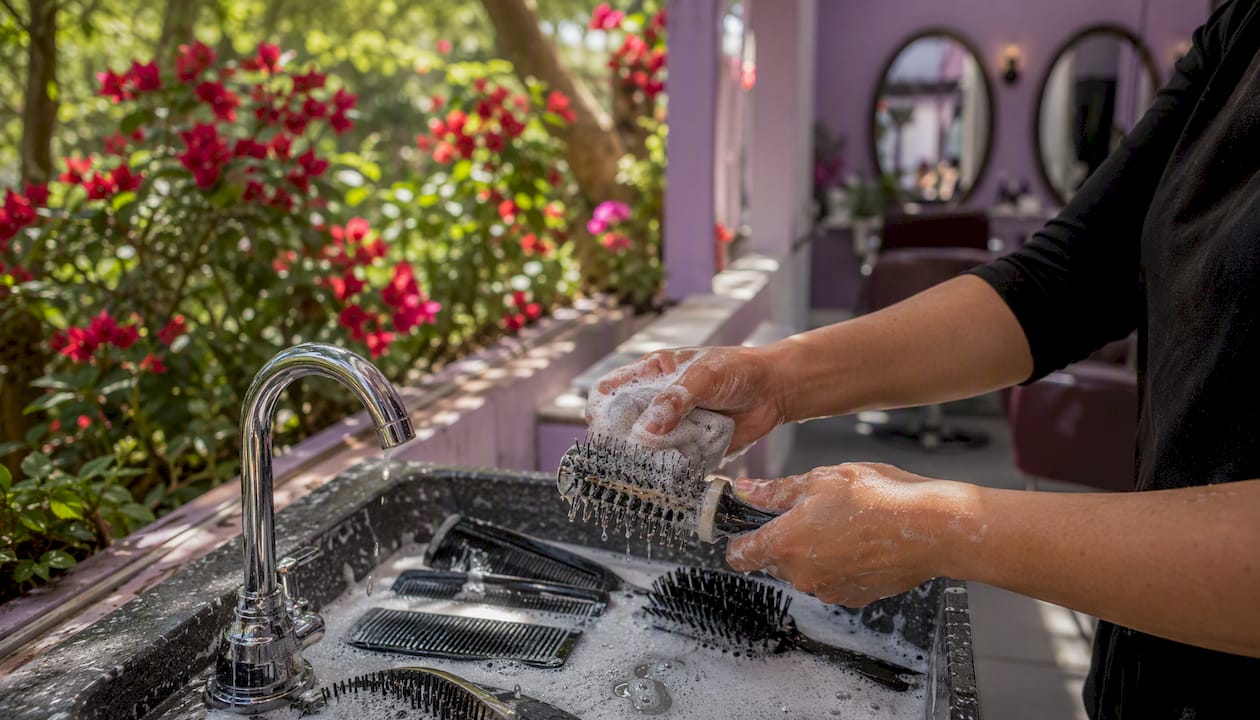
Remove all hair manually. Wash with warm water and detergent, scrubbing bristles with a brush cleaner. Rinse thoroughly. Immerse in a low-level disinfectant solution for the full contact time. Remove, rinse if the label requires it, and air dry on a clean towel. Store in a covered container.
Clippers and trimmers
Remove the blade and guard. Brush out all hair. Spray the blade with a clipper-specific disinfectant spray (confirm DIN on label) and allow the full contact time. Wipe the body of the clipper with a damp cloth and surface disinfectant wipe. Reattach the blade only after both parts are dry.
Razors and single-use blades
Single-use blades must be discarded after each client into a puncture-resistant sharps container. Never reuse a disposable blade. Straight razors with replaceable blades follow the same rule for the blade; the handle is cleaned and low-level disinfected between clients.
Manicure and pedicure implements (metal)
Clean with a brush under running water and detergent to remove all debris from crevices. For non-critical use (intact skin only), low-level disinfection is the minimum. Where skin is broken or the service is more invasive, use high-level disinfection by full immersion. Use tongs to remove items from high-level solutions; do not reach in with bare hands.
Pedicure footbaths
This is the highest-risk piece of equipment in most salons. After each client:
- Drain the basin completely.
- Remove and clean the screen or filter, scrubbing to remove all debris.
- Wash the basin with detergent and water.
- Rinse thoroughly.
- Fill with fresh disinfectant solution at the correct dilution and run the recirculation system for the manufacturer’s specified time.
- Drain and allow to air dry.
At the end of the day, repeat the full process and dispose of all disinfectant solutions. The NWT standards and the PEI guidelines both require daily solution disposal and circulation through the system — not just basin filling.
Linens and capes
Use clean linens for every client. Soiled linens go directly into a covered laundry bin, not left on chairs or counters. Wash in hot water with detergent. Store clean linens in a covered, clean area away from soiled items.
Do-not-do list:
- Do not top up disinfectant solutions
- Do not use dried-out disinfectant wipes, as they have lost efficacy
- Do not use skin antiseptics (hand sanitiser, rubbing alcohol from a first-aid kit) as surface disinfectants
- Do not treat boiling water or UV light as sterilization methods, as neither meets the Canadian standard for sterilization of critical items
- Do not accept a U.S. EPA or FDA number as proof of Canadian authorisation
Pro Tip: For porous items you cannot adequately disinfect (pumice stones, nail files, wooden cuticle sticks, sponges), single-use is the only compliant option. Buy in bulk and factor the cost into your service pricing rather than trying to reprocess items that cannot be made safe.
5. Logs, signage, and what inspectors actually look for
The biggest surprise for many salon owners at their first inspection is that the inspector is not just checking whether you have disinfectant on the shelf. They are checking whether you can prove you used it correctly, every day, for every client. Documentation is the difference between a pass and a written order.
What to record in your disinfection log:
- Product name and DIN or MDL
- Lot number and expiry date
- Date and time of solution preparation
- Dilution used (volume of product and volume of water)
- Contact time applied
- Test-strip reading (for high-level solutions) and pass/fail result
- Staff initials
- Date and time of disposal
Keep a separate log for each high-level disinfectant solution in use. A single binder with dated pages works well; digital logs are acceptable in most provinces provided they can be printed on request.
Employee training records to maintain:
- Name of staff member and date of training
- Topics covered (cleaning sequence, disinfection levels, PPE use, SDS access, post-exposure procedure for blood or body fluid contact)
- Name of trainer or training resource used
- Date of next scheduled refresher (annually at minimum; more often when products or procedures change)
Signage and SDS placement inspectors check:
- SDS binder accessible at or near each workstation (not locked in a back office)
- Contact-time notice posted at the disinfection station (product name, dilution, contact time)
- Hand-hygiene poster at every sink
- Sharps disposal container labelled and within reach of any service involving blades
| Log type | Minimum frequency | Key fields |
|---|---|---|
| High-level disinfectant concentration check | Daily (before first use) | Product, DIN, test-strip result, staff initials |
| Tool reprocessing record | Per client or per session | Tool type, cleaning method, disinfectant used, contact time |
| Footbath cleaning record | After each client and end of day | Drain, clean, disinfect, circulate, dispose — time and initials |
| Staff training record | At hire and annually | Staff name, topics, trainer, date |
| SDS review record | When products change | Product name, DIN, review date, staff initials |
Pro Tip: Organise your binder with tabbed sections: Products (label copies, DIN list), Logs (daily sheets), Training (staff records), and SDS. An inspector who can find everything in under two minutes is far less likely to dig further.
6. Province and territory quicklinks to official standards
Every province and territory has its own enforceable personal service standards. The national framework is consistent, but local inspectors enforce local rules. Use the links below to download the document that applies to your jurisdiction.
- Ontario: Public health units enforce the Health Protection and Promotion Act. The Public Health Ontario IPAC guide for personal service settings is the primary reference. York Region Public Health also offers a practical checklist and service-specific guidance. Look for the instrument classification table and footbath protocol in both documents.
- Alberta: Alberta Health Services publishes the Personal Services Standards. Download from the Alberta Health Services website. Pay close attention to the footbath recirculation requirements and mandatory staff training provisions.
- British Columbia: The BC Ministry of Health and regional health authorities publish personal service establishment guidelines. Check your regional health authority’s website for the current version; BC guidance emphasises daily concentration checks for high-level solutions.
- Prince Edward Island: The PEI Personal Service Guidelines are detailed and practical, with active ingredient lists by disinfection level and step-by-step dilution and disposal instructions. Useful as a reference even outside PEI.
- Northwest Territories: The NWT Standards for Personal Service Establishments include classification tables, footbath biofilm controls, and daily solution disposal requirements. The footbath section is among the most detailed in any Canadian jurisdiction.
- Manitoba: Manitoba Health publishes guidelines for personal service facilities. Check the Manitoba Health website for the current document; look for the log templates and signage requirements.
- Saskatchewan: Saskatchewan Health Authority provides personal service standards. The instrument classification table and training requirements are the sections to review first.
- Nova Scotia: Nova Scotia Environment and Climate Change regulates personal service establishments. Download the current standards from the provincial government website.
- New Brunswick: New Brunswick Department of Health publishes personal service guidelines. Check for footbath and high-level disinfection requirements specific to esthetics services.
- Newfoundland and Labrador: The Department of Health and Community Services sets personal service standards. Review the reprocessing and log requirements.
- Quebec: The Loi sur les établissements d’hébergement touristique and public health regulations apply. Contact your regional public health directorate (Direction de santé publique) for the applicable standards.
- Yukon: Yukon Environmental Health Services sets personal service standards. Contact the regional office for the current document.
- Nunavut: Contact the Department of Health for applicable standards in your community.
What to look for in each provincial document: the instrument classification table, the footbath cleaning protocol, required log formats, and any mandatory staff training or certification requirements. Those four sections cover the majority of inspection findings.
7. Printable compliance checklist and sample logs
The checklist below is ready to print, laminate, and post at your disinfection station. Adapt the product name and DIN fields to match your actual products.
Daily compliance checklist
Before opening:
- [ ] Prepare fresh disinfectant solutions at correct dilution; label containers with product name, DIN, dilution, and date
- [ ] Test high-level disinfectant concentration with manufacturer test strips; record result in log
- [ ] Confirm SDS binder is accessible at each workstation
- [ ] Check PPE stock (gloves, eye protection, mask where required)
- [ ] Confirm sharps containers are in place and not overfull
Between each client:
- [ ] Remove all visible debris from tools before applying any disinfectant
- [ ] Clean tools with detergent and water; rinse
- [ ] Apply disinfectant at correct dilution; allow full contact time per label
- [ ] Disinfect workstation surface, chair, and arm rest
- [ ] Replace linens and capes with clean items
- [ ] For footbaths: drain, clean screen, wash basin, disinfect, circulate solution, drain
End of day:
- [ ] Dispose of all disinfectant solutions; do not store for next day
- [ ] Clean and disinfect all workstations and common surfaces
- [ ] Wash all reusable linens in hot water with detergent
- [ ] Empty and clean sharps containers if full; seal and label for disposal
- [ ] Complete daily log entries; initial and date
Weekly:
- [ ] Review SDS for any products changed or added
- [ ] Check expiry dates on all disinfectant products
- [ ] Review staff training records; schedule refreshers if due
- [ ] Inspect labelled containers for legibility and accuracy
Sample daily high-level disinfectant log
| Date | Product name | DIN/MDL | Dilution prepared | Test-strip result | Pass/Fail | Disposal time | Staff initials |
|---|---|---|---|---|---|---|---|
| Example | [Product name] | [Number] | [e.g., 1:10] | [e.g., 500 ppm] | Pass | [Time] | [Initials] |
Pro Tip: Print two weeks of log sheets at a time and clip them to the inside cover of your binder. When the sheet is full, move it to the archive tab. Inspectors appreciate seeing a continuous, unbroken record — gaps raise questions.
York Region Public Health’s spa and salon safety page offers additional checklist language and service-specific guidance you can incorporate into your own templates.
8. Common inspection failures and how to fix them fast
Most failed inspections come down to a short list of recurring problems. None of them require expensive equipment to fix.
The most common findings, and what to do:
- Contact time not honoured: Disinfectant wiped off before the label time has elapsed. Fix: post the contact time at every station and set a timer. Under 15 minutes to implement.
- Solutions topped up instead of replaced: Concentration drops below effective level and contamination accumulates. Fix: discard at end of day, prepare fresh each morning. Policy change, zero cost.
- No DIN or MDL on the product: Using a product not authorised for disinfection in Canada. Fix: check every product today; replace any without a DIN or MDL before the next client. Same day.
- Missing or incomplete logs: No record of concentration checks, contact times, or disposal. Fix: print the sample log above and start today. Under 15 minutes.
- Unlabelled decanted containers: Inspector cannot confirm what is in the bottle or whether it is correctly diluted. Fix: label every container now with product name, DIN, dilution, and date. Under 15 minutes.
- Dried-out disinfectant wipes: Wipes left open or used past their effective period. Fix: seal containers after each use; check wipes are visibly wet before applying. Immediate.
- Footbath not circulated: Basin filled but recirculation system not run; biofilm risk remains. Fix: run the recirculation cycle per manufacturer instructions after every client. Procedural change.
- Porous items reused: Pumice stones, nail files, or wooden sticks used on more than one client. Fix: switch to single-use for all porous items. Same day.
- SDS not accessible: Binder locked away or not at the workstation. Fix: move the binder to the workstation today.
- No staff training records: Cannot demonstrate that staff know the procedures. Fix: document a brief training session today; record names, topics, and date.
Quick-fix priority order:
- Under 15 minutes: label containers, post contact times, move SDS binder, start a log sheet
- Same day: replace non-DIN products, switch porous items to single-use, brief staff and document it
- Policy change: no topping up solutions, daily log review, annual training schedule
Pro Tip: Prepare an “inspection binder” with four tabbed sections: Products (DIN list and label copies), Logs (current and archived), Training (staff records), and SDS. When an inspector arrives, hand it over immediately. It signals competence and typically shortens the inspection.
A practical note from Rohit at Salonbrandz
The compliance framework in this guide is well-established and consistent across Canadian jurisdictions. What is less consistent is how salons actually implement it day to day. The gap between knowing the rules and running a clean, documented operation is almost always an operational one, not a knowledge one.
Stock rotation matters here. High-level disinfectants have short reuse periods once opened; buying in quantities you can actually use before expiry reduces waste and keeps your concentrations reliable. Single-use items for porous surfaces are not a luxury — they are the only compliant option, and buying them in bulk from a Canadian supplier keeps costs manageable.
This guide is practical help, not legal advice. Confirm your specific local requirements with your municipal or regional public health unit before your next inspection.
Salonbrandz: Canadian-stocked supplies for compliant salons
Running a compliant salon means having the right products on hand before an inspector arrives, not scrambling to find them after. Salonbrandz stocks professional salon supplies and ships across Canada, with in-store pickup available in Scarborough near Toronto.
For compliance-related supplies, look for Health Canada-authorised disinfectants (always verify the DIN or MDL on the label), test strips for daily concentration checks, labelled dispensing containers, and single-use disposables for porous items. Salonbrandz carries professional-grade products across these categories, sourced from brands trusted by Canadian salon operators.
Visit Salonbrandz to browse the full range of professional salon supplies available for delivery across Canada or pickup in Scarborough. For broader salon business resources, Lumari Pro also offers operational guidance for salon owners.
This article provides general compliance guidance only and is not a substitute for advice from your local public health unit. Confirm all requirements with the authority having jurisdiction in your area.
Sources
The official documents below are the primary references for Canadian salon disinfection requirements. Download and bookmark the one for your province.
- Health Canada — Disinfectant drugs: summary of guidance documents
- Spa and salon safety (York Region Public Health)
FAQ
When should a salon professional clean, disinfect, and sterilize?
Clean to remove visible debris before every disinfection step. Disinfect non-critical and semi-critical items between every client. Sterilize critical items (anything that pierces skin) before each use, or use single-use disposables.
What is the correct procedure for reusable salon tools?
Remove debris, wash with detergent and water, rinse, apply the appropriate level of disinfectant at label dilution for the full contact time, rinse if required, dry, and store in a clean covered container. Semi-critical items require full immersion in a high-level disinfectant.
Do disinfectants used in Canadian salons need a DIN or MDL?
Yes. Under the Food and Drugs Act, disinfectants sold and used in Canada must carry a Drug Identification Number (DIN) or, for high-level disinfectants and liquid chemical sterilants, a Medical Device Licence (MDL). U.S. EPA or FDA registration numbers are not accepted.
What do salons use to disinfect tools in Canada?
Semi-critical items require high-level disinfectants such as enhanced hydrogen peroxide or peracetic acid with an MDL, applied by full immersion for the manufacturer’s stated contact time.
How often should high-level disinfectant solutions be tested and replaced?
Test the concentration daily with the manufacturer’s specified test strips before first use, and record the result. Discard and replace the solution at the end of each day, or immediately if the test-strip reading falls below the minimum effective concentration stated on the label.


