

Storing hair colour safely: the rules every salon should follow
Store unopened hair colour and developers in a cool, dark, dry space between 15°C and 22°C. Discard any mixed colour once it’s applied. Those two habits alone prevent most of the quality failures and safety complaints salons deal with.
The rest comes down to reading the period after opening (PAO) symbol on every tube and bottle, keeping hydrogen peroxide developers away from heat, and never letting mixed colour sit “just in case.” Salon Brandz builds its packaging and technical sheets around these exact PAO markers, so the labelling you already have on hand is the starting point, not an afterthought.
Three things to do before your next shift:
- Check the PAO symbol (the little open-jar icon) on every product at your station and confirm nothing’s past its stated months-after-opening window.
- Pull any half-used mixed colour out of the tray and toss it. It cannot be saved, refrigerated, or reused.
- Label every opened tube or bottle with the date it was opened, right on the cap or shoulder.
Key Takeaways
Hair colour stays chemically stable only within a narrow window of temperature, light, and air exposure, and mixed colour has no safe storage option at all.
| Point | Details |
|---|---|
| Hold the temperature band | Keep unopened colour and developer between 15°C and 22°C, away from dryers, ovens, and sunny walls. |
| Discard mixed colour every time | Mixed oxidative colour stays usable for roughly 25 to 35 minutes at room temperature and cannot be saved. |
| Label the open date | Calculate a use-by date from the PAO symbol and apply a safety margin for humid salon conditions. |
| Separate and refrigerate developer | Keep peroxide developer on its own dedicated fridge shelf, away from colour creams and personal food. |
| Build storage around Salon Brandz supplies | Salon Brandz stocks opaque storage containers and PAO-labelled colour lines suited to these exact protocols. |
Table of Contents
- What is hair colour storage safety and why does it matter?
- Recommended storage conditions for hair colour and developer
- How to manage opened colour and developer between clients
- Why developer needs special handling and mixed colour can’t be stored
- PPE and ventilation salons need for colour work
- Patch testing, training, and recordkeeping that hold up
- What to do when colour products spill or cause a reaction
- Which guidance should actually shape your salon’s SOPs?
- A one-week storage fix any salon can start today
- The gap between shelf-life labels and how salons actually use product
- Get your storage setup right with Salon Brandz
- Sources
- FAQ
What is hair colour storage safety and why does it matter?
Hair colour storage safety means controlling temperature, light, air exposure, and time so that colour products stay chemically stable from the moment they’re opened until they’re used. Get any one of those wrong and you’re looking at colour that oxidizes early, developer that loses strength, or a product that separates and burns skin instead of tinting hair.
Most salons treat storage as a shelving question. It’s actually a chemistry question, and the difference matters more than most technicians realize. Hair colour and developer are formulated to behave predictably under specific conditions. Heat, light, and air all push those formulas off their intended chemistry, sometimes in ways you can smell or see, sometimes not until the product’s already on a client’s head and behaving strangely.
Recommended storage conditions for hair colour and developer
Aim to keep colour products between 15°C and 22°C (59°F to 72°F). That’s a narrower band than most back-bar storage actually achieves, especially in salons where the colour station shares a wall with a blow-dry area or sits near a west-facing window.
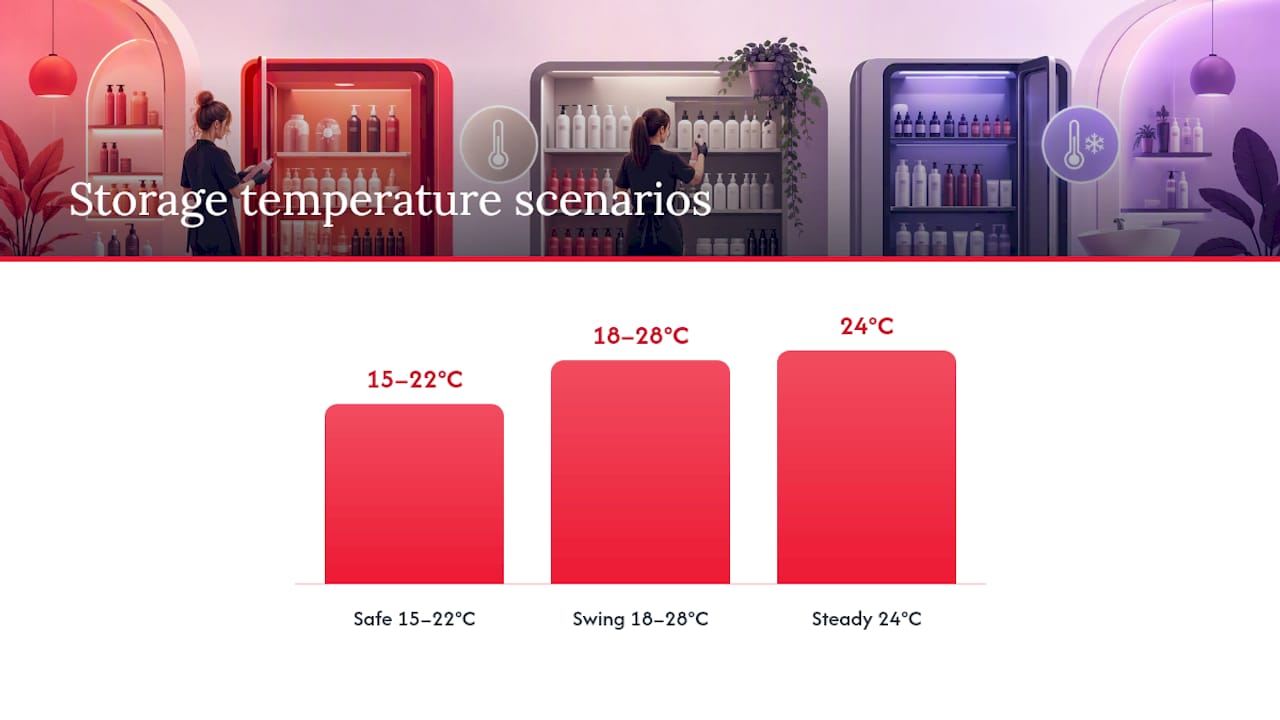
Temperature swings do more damage than steady heat. A shelf that hits 28°C during afternoon sun and drops to 18°C overnight puts more stress on peroxide stability than a room that holds a constant 24°C. If your storage area doesn’t have a thermometer, get one. Most technicians are surprised by how hot a “cool” back room actually gets by 3 p.m. in summer.
Humidity and placement
Keep colour storage away from:
- Blow-dryer stations and any equipment that vents heat
- Ovens, water heaters, or laundry equipment in back rooms
- Exterior walls that take direct sun, especially in un-insulated buildings
- Anywhere humidity regularly climbs above the low-moderate range, since damp cardboard packaging degrades and tube seals can corrode
Light control
Hair dye intermediates, including p-phenylenediamine (PPD), are photosensitive. Store products in opaque containers or closed cabinets, not open glass-front displays that look nice but bathe every tube in ambient light all day. If you’re retrofitting a display cabinet, opaque polypropylene drawers are a cheap fix that does more for shelf life than a fancier shelving unit with glass doors.
Orientation and separation
Store colour tubes upright, cap up, to keep product away from the cap seal and reduce leakage risk. Keep developers on a separate shelf from colour creams entirely. It’s a simple habit that prevents the two most common back-bar accidents: a leaking developer bottle contaminating cream tubes below it, and staff grabbing the wrong bottle in a rush.
Manufacturers typically state an unopened shelf life of several years under ideal conditions under ideal storage conditions, according to L’Oréal Paris. That number assumes the temperature and light conditions above. A tube baked on a sunny shelf for two summers won’t make it anywhere close to three years.
Refrigeration helps developers specifically, since hydrogen peroxide breaks down faster with heat and refrigeration slows that decomposition according to EPA chemical summaries. It can hurt cream-based colour tubes, though: condensation inside a fridge can seep past cap threads over repeated open/close cycles, introducing moisture that destabilizes the cream base. Refrigerate developer bottles in a dedicated space, and leave colour cream tubes at room temperature within the target band instead.
How to manage opened colour and developer between clients
Once a tube or bottle is opened, the clock starts. Air exposure accelerates oxidation in colour cream and speeds up peroxide breakdown in developer, so the goal is minimizing how much air gets in every time you open, use, and reseal a container.
- Squeeze air out before capping. Push remaining product toward the opening and expel trapped air before you replace the cap. This is the single easiest habit to build and the one most stations skip.
- Store opened tubes cap down where the design allows it, which keeps product against the seal rather than air pooling at the opening.
- Use vacuum-sealed lids or nitrogen-spray systems for high-volume bottles if your salon’s budget allows. Where it doesn’t, a tight-fitting pump cap or a purpose-built decanting bottle with a one-way valve gets you most of the benefit for a fraction of the cost.
- Label the open date the day you crack the seal. Calculate a use-by date from the manufacturer’s stated PAO months, then shave a safety margin off that number for salon conditions.
- Rotate stock FIFO. New deliveries go behind, not in front of, existing open stock, so the oldest product gets used first.
Pro Tip: Treat the manufacturer’s PAO window as the ceiling, not the target. If a developer’s PAO symbol says 12 months, plan to use it up within roughly eight or nine months in a busy, humid salon. Stylists who lean on the PAO symbol as their primary shelf-life guide consistently report fewer inconsistent colour results.
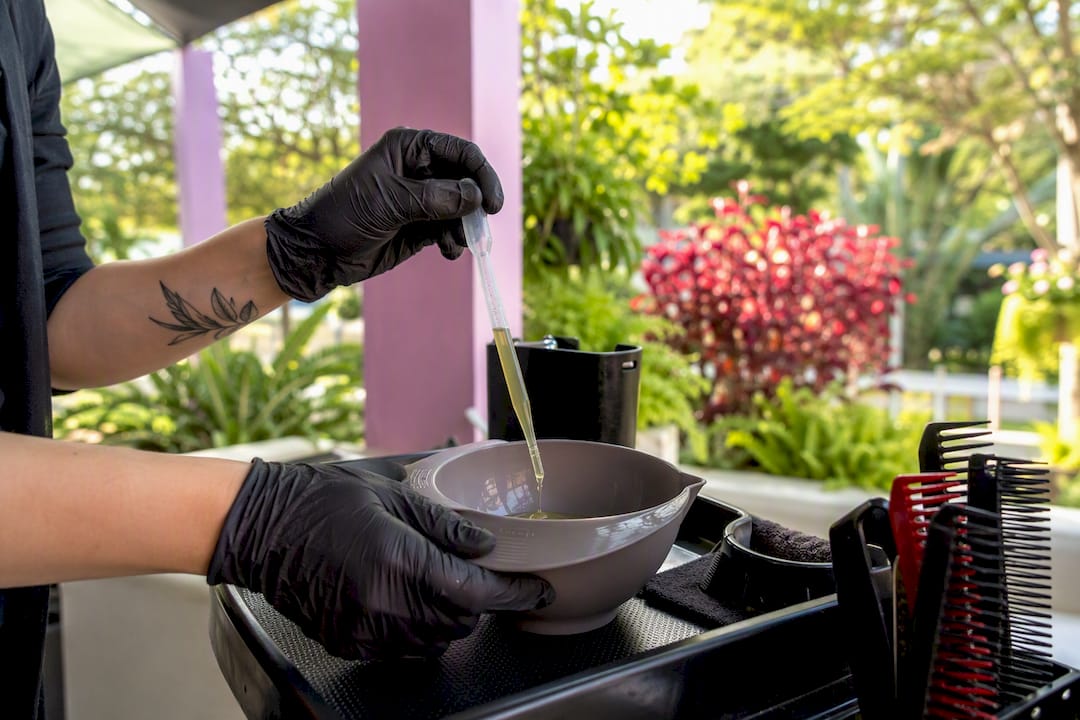
One more habit worth locking in: never dip a fresh brush or spatula back into a stock bottle after it’s touched a bowl of mixed colour. Use single-use pipettes or dedicated pumps for dispensing, and keep bulk containers untouched by anything that’s already been near a client’s hair. Cross-contamination from re-dipping is one of the quieter causes of a whole bottle going off early.
Why developer needs special handling and mixed colour can’t be stored
Peroxide developer is the most chemically fragile product on your shelf, and it’s also the one salons most often mishandle by storing it wherever there’s space.
Hydrogen peroxide decomposes faster as temperature rises, and its stabilizers break down alongside it, which is why a developer bottle that’s spent a summer near a window can lose potency well before its stated expiry. Refrigeration slows that decomposition meaningfully, which is why a dedicated fridge shelf, kept exclusively for developer and never for food or personal items, is worth the investment for any salon doing regular colour work.
Once colour and developer are mixed, the oxidative reaction starts immediately, and following proper hair coloring safety precautions is essential to prevent issues. Mixed product typically stays usable for a limited time at room temperature, less than an hour before it begins losing effectiveness, based on industry storage guidance. There is no safe way to store leftover mixed colour for a later client or a later hour. Not in the fridge. Not with the cap back on. It’s chemically already reacting and continuing to change from the moment the two components meet.
If a service runs long and you need extra time, mix a fresh, smaller batch rather than stretching existing mixed product past its working window. For leftover mixed colour, don’t pour it straight down the drain in bulk. Let it fully react and neutralize per your supplier’s disposal guidance, then dispose of the empty bowl and applicator in your regular waste stream, keeping any bulk chemical waste separate per your local disposal rules.
PPE and ventilation salons need for colour work
PPE isn’t optional gear for colour services. PPD, found in most permanent oxidative dyes, is a recognized sensitizer, and repeated exposure raises the risk of allergic contact dermatitis over a career, not just after one bad reaction according to PubChem data.
Glove and skin protection
- Wear nitrile gloves rather than latex. Nitrile resists the chemical penetration that latex allows over repeated exposure.
- Change gloves between clients, and mid-service if a glove tears or colour seeps past the cuff.
- Apply a barrier cream along the hairline before application, both for the client’s skin and to reduce your own hand-to-skin transfer risk during rinsing.
- Wear eye protection when mixing powder lighteners or working with any product prone to splashing.
Ventilation
Stagnant air is the enemy here. Salons should aim for real air turnover in the colour area, not just a ceiling fan pushing the same air around. Local exhaust near the colour station, or at minimum an open window paired with a fan pulling air outward, cuts down on the ammonia and VOC buildup that accumulates over a full day of back-to-back colour services. Consumer Reports testing found real variability across boxed dyes in VOC and phthalate content, and flagged chronic, repeated occupational exposure as the bigger concern for professionals versus a single at-home use.
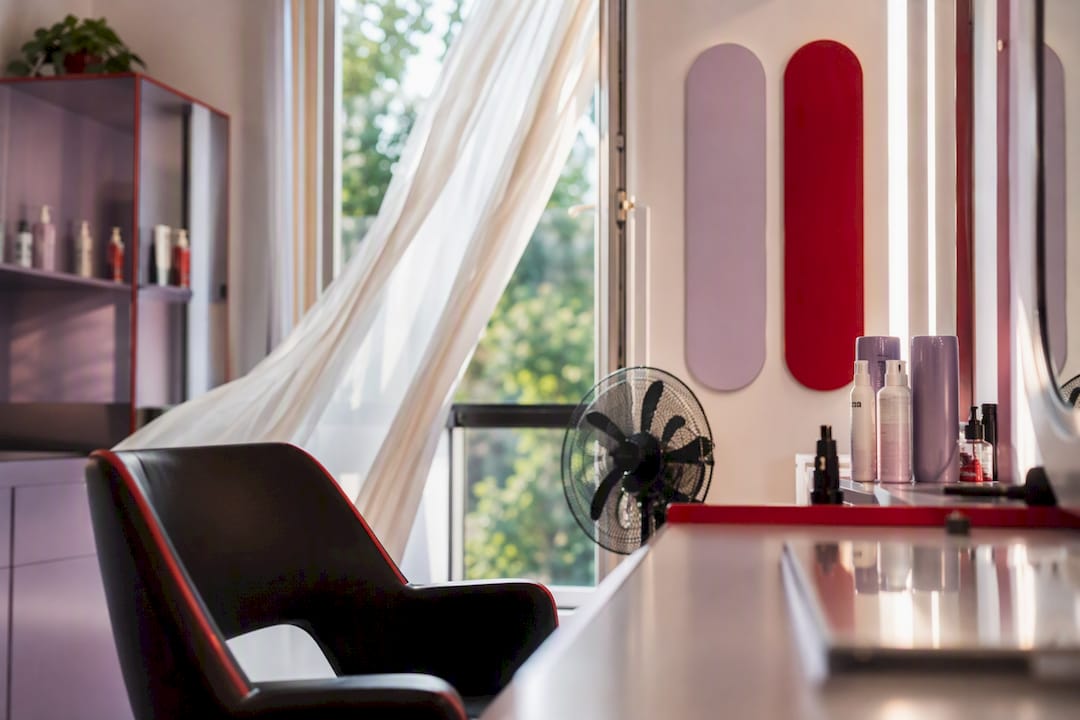
If a client discloses a respiratory condition, or you’re working with a high-ammonia lightener on a low-ventilation day, move the service to your best-ventilated station or reschedule. It’s a small operational shift that avoids a genuinely bad outcome for both the client and the technician doing eight more colour services that same week.
Patch testing, training, and recordkeeping that hold up
A 48-hour patch test before first-time use of a new colour line isn’t a suggestion; treat it as non-negotiable for any client without a documented reaction history on that specific formula. Given how PPD sensitization builds with repeated exposure, a client who tolerated a brand two years ago can still react today.
- Patch test 48 hours before service, applied to skin behind the ear or on the inner elbow, and documented with date and result in the client file.
- Retrain staff on storage and PPE protocols quarterly, not just at onboarding. Habits drift, and a quarterly five-minute refresher catches the drift before it becomes a pattern.
- Assign one person to sign off on competency after each training session, with a simple checklist rather than an informal “yeah, they know it.”
- Keep three running logs: an inventory log with open-dates, a patch-test log per client, and an incident-report log for any reaction, spill, or near-miss.
Salons that formalize this paperwork rarely find it burdensome once it’s built into the routine. The value shows up the one time a client alleges a reaction and you can produce a dated patch-test record instead of relying on memory.
What to do when colour products spill or cause a reaction
Every station should have a small spill kit within arm’s reach: absorbent pads, nitrile gloves, eye-wash solution, and a sealed disposal bag.
For a chemical spill, contain it immediately with absorbent material, ventilate the area, and dispose of contaminated material per your product’s safety data sheet rather than rinsing large volumes down the sink.
For eye contact, flush with clean water for at least 15 minutes and seek medical attention, particularly with any peroxide or ammonia-based product, following the same first-aid pattern outlined in CDC chemical exposure guidance for common salon chemicals.
For a severe allergic reaction (facial swelling, difficulty breathing, spreading hives), call emergency services immediately. Don’t wait to see if antihistamines help first.
After any incident, document it in your incident log the same day, including product batch number, and notify the manufacturer if the reaction appears formula-related rather than client-specific. That batch information matters if a pattern emerges across multiple clients using the same lot.
Which guidance should actually shape your salon’s SOPs?
Manufacturer safety data sheets and PAO symbols tell you what a product is designed to do under lab conditions. CCOHS guidance for hairdressers tells you how to translate that into a workplace routine that accounts for real salon variables like heat, humidity, and repeated daily exposure.
Use both together, not one instead of the other:
- Treat manufacturer PAO months as a ceiling, and apply a safety margin for humid or high-traffic salons rather than using every last day of the stated window.
- Follow CCOHS storage and ventilation guidance as your baseline SOP, since it’s written specifically for the occupational realities of salon work, not general consumer use.
- Keep SDS sheets accessible at every station, not filed away in an office binder nobody opens.
- Write your SOPs down and post them where staff actually see them daily. A visible, dated SOP holds up far better in a liability review than an unwritten “we all just know” system.
A one-week storage fix any salon can start today
A mid-sized salon switching from open glass shelving to opaque, temperature-controlled storage typically sees fewer product returns and less discarded stock within the first few months, simply because product stops degrading before it gets used. That mirrors what Salon Brandz sees across its wholesale clients: the salons with the fewest colour-related complaints are almost always the ones with the most boring, consistent storage habits, not the ones with the fanciest product line.
You don’t need a renovation to fix most of this. Here’s a realistic one-week plan:
- Day 1: Swap one open or glass-front shelf for opaque storage bins and move all colour cream there.
- Day 2: Designate a fridge shelf exclusively for developer bottles, no exceptions for lunch items.
- Day 3: Label every currently open tube and bottle with its open date.
- Day 4: Set up a FIFO system for new deliveries using simple inventory tracking.
- Day 5 through 7: Train staff on the squeeze-and-cap-down routine and confirm everyone knows where the spill kit lives.
Rohit’s product notes for Salon Brandz’s professional colour lines walk through PAO interpretation product by product, which is a useful follow-up once the basics above are locked in.
The gap between shelf-life labels and how salons actually use product
Most storage advice out there reads like it was written for a warehouse, not a working station with eight colour services booked before 3 p.m. That’s the real gap: manufacturer PAO labels assume steady conditions and predictable use, but a busy salon shelf gets opened, closed, jostled, and reheated by ambient traffic dozens of times a day.
The conventional advice tells you to “follow the expiry date.” Fine, but the expiry date on the box was calculated under lab conditions your back room will never match. The technicians who get this right aren’t the ones with the most expensive storage systems. They’re the ones who treat the PAO symbol as a countdown that started the day they opened the tube, not a distant deadline to worry about later.
If you only fix one thing after reading this, fix the mixed-colour rule. Discarding leftover mixed product feels wasteful in the moment, but it’s the single highest-risk habit in most salons, and it’s also the easiest one to correct starting with your very next client.
Get your storage setup right with Salon Brandz
Building compliant, PAO-aligned storage doesn’t require a renovation budget, and it doesn’t require guessing what “cool and dark” actually means for your specific back bar. Salon Brandz supplies the opaque storage containers, professional colour lines with clear PAO labelling, and developer products built for the refrigeration routines covered above, all shipped across Canada with in-store pickup available in Scarborough.
If your current setup involves glass shelving under a window or a developer bottle sharing fridge space with someone’s lunch, that’s a same-day fix, not a project. Browse Salon Brandz’s professional colour and storage supplies to find opaque bins, labelling systems, and developer lines sized for your station volume, and place an order with delivery across Canada or pickup in Scarborough this week.
Sources
- Some Boxed Hair Dyes Contain Fewer Toxins Than Others - Consumer Reports
- Does Hair Dye Have an Expiration Date? - L’Oréal Paris
- P-Phenylenediamine - PubChem
- p-Phenylenediamine (P-Phenylenediamine) - EPA
FAQ
How long can hair colour be stored?
Unopened hair colour typically stays potent for about three years under cool, dry, dark storage. Once opened, follow the PAO symbol’s stated months rather than the unopened shelf life.
Why can’t you save unused hair dye?
Once colour and developer are mixed, the oxidative reaction starts immediately and the product stays usable for only around 25 to 35 minutes at room temperature before it degrades. There’s no refrigeration or resealing method that halts that reaction.
Why do hairdressers say not to use box dye?
Box dye is formulated for single, predictable home use, while salon products come with PAO guidance and stability data built for repeated professional handling. Independent testing has also found variability in VOCs, phthalates, and heavy metals across boxed products, which matters more for professionals with daily chronic exposure than for an occasional home user.
What is the safest store-bought hair colour?
Safety depends less on the brand and more on storage discipline. A product stored within its PAO window, kept cool and dark, and never re-mixed after its working window will outperform a “safer” brand that’s been left in a hot, sunlit cabinet for months.
Do I need to refrigerate hair developer?
Refrigeration slows the thermal breakdown of hydrogen peroxide and can extend a developer’s useful life. Use a dedicated fridge shelf for developer only, since condensation cycles can damage cream-based colour tubes stored the same way.


